
TLDR
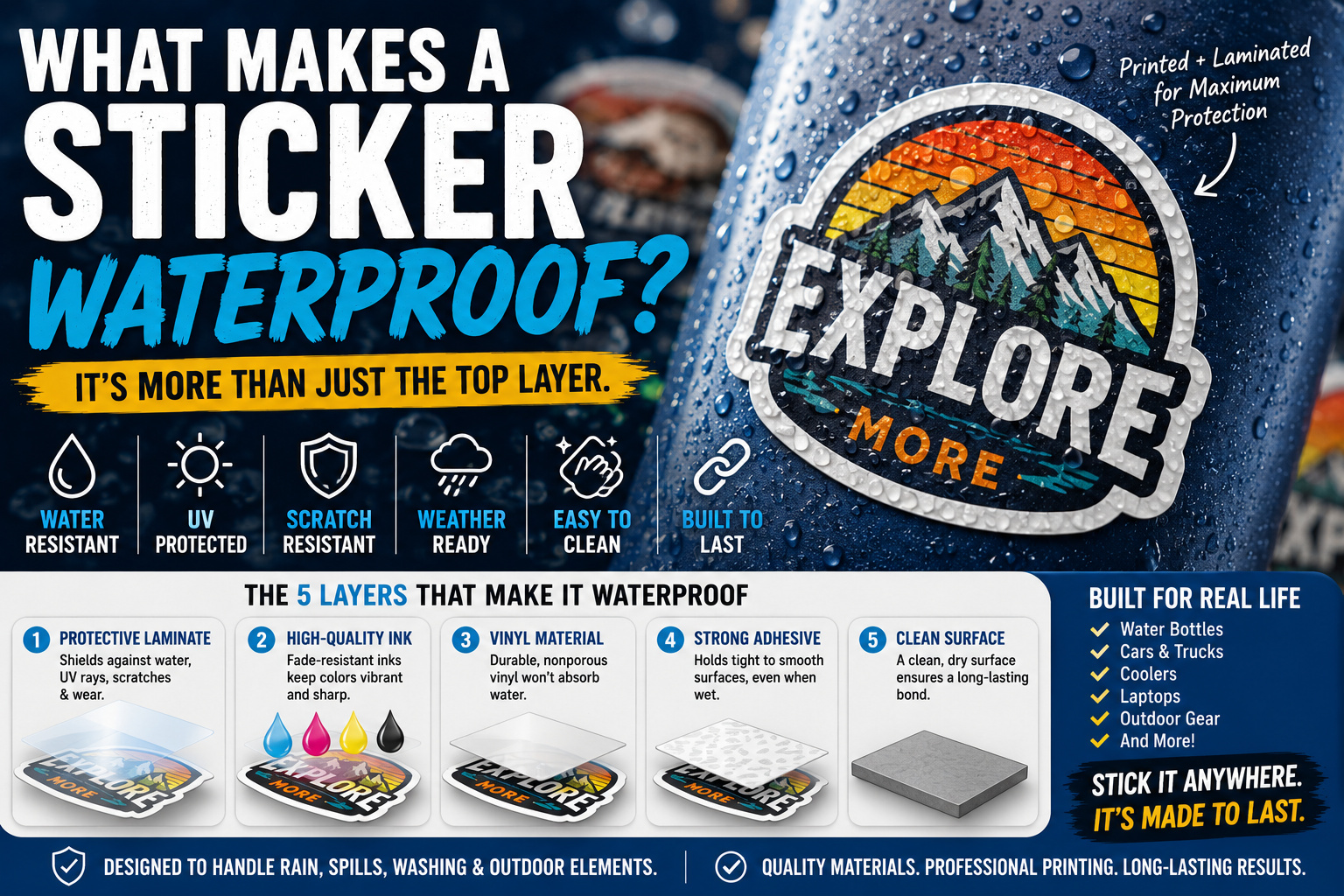
A waterproof sticker depends on the complete construction, not one material.
The most reliable waterproof stickers combine:
- A nonporous vinyl or film base
- Water-resistant printing
- A protective laminate
- Adhesive suited to the surface and environment
- Clean, dry application
- Fully pressed edges
Laminated vinyl stickers can usually handle rain, spills, handwashing, damp outdoor conditions, and normal use on water bottles. Dishwashers, pools, saltwater, pressure washing, and long-term submersion are harder conditions.
“Waterproof” also does not mean indestructible. Heat, detergent, chemicals, UV exposure, abrasion, and lifted edges can eventually wear down any sticker.
A sticker gets wet in more ways than one. A package may encounter condensation. A water bottle gets washed and handled. A vehicle deals with rain, snow, road spray, and car washes. A cooler may sit beside a pool all summer.
Some stickers handle those conditions without much trouble. Others wrinkle, bleed, soften, or peel after one wet afternoon.
So, what makes a sticker waterproof? It is not simply a waterproof top layer. The face material, ink, laminate, adhesive, edges, surface, and application all have to work together.
Waterproof vs Water-Resistant vs Weatherproof Stickers
These terms are often used as if they mean the same thing, but they describe different levels or types of exposure.
Water-Resistant Stickers
A water-resistant sticker can handle limited contact with moisture.
That may include:
- Small spills
- Humidity
- Condensation
- Brief contact with rain
- Wiping with a damp cloth
Water resistance does not necessarily mean the sticker can survive frequent washing or prolonged outdoor use.
Some coated paper labels are water-resistant enough for refrigerated packaging or occasional condensation. But once water reaches an exposed paper edge, the material may absorb moisture and begin to swell or soften.
Waterproof Stickers
A waterproof sticker is made from materials that do not readily absorb water and uses printing and finishing that can withstand regular wet conditions.
Laminated vinyl is the most common choice for waterproof custom stickers. The vinyl provides a nonporous base, while the laminate protects the printed surface from moisture and physical wear.
YouStickers prints custom vinyl stickers on durable vinyl with a laminated finish intended for exposure to water, weather, sunlight, and routine handling.
Weatherproof Stickers
Weatherproof stickers are built for broader outdoor exposure.
In addition to moisture, they may need to tolerate:
- Sunlight
- Changing temperatures
- Snow and ice
- Humidity
- Wind-driven dirt
- Salt spray
- Scratches
- Outdoor washing
A weatherproof sticker is usually waterproof enough for normal rain, but the word also considers conditions beyond water alone. YouStickers recommends weatherproof laminated vinyl for outdoor surfaces, bottles, coolers, vehicles, and other applications exposed to moisture and regular wear.
The Sticker Material Is the First Layer of Protection
The face material is the printable layer that gives the sticker its basic structure.
Vinyl Stickers
Vinyl is a strong choice for waterproof stickers because it does not absorb water the way untreated paper does.
It can also flex slightly, which helps when the sticker is applied to curved bottles, coolers, helmets, vehicle panels, and other surfaces that are not perfectly flat.
Vinyl alone does not guarantee a durable finished sticker. The print, laminate, adhesive, and application still matter. But it provides a much better starting point for wet environments than ordinary paper.
Paper Stickers
Standard paper stickers are usually best for dry indoor applications.
They work well for:
- Shipping boxes
- Product packaging
- Envelopes
- Retail bags
- Indoor event materials
- Temporary labels
Some paper stocks have water-resistant coatings, but exposed edges remain vulnerable. Moisture can cause paper stickers to wrinkle, tear, stain, or separate into layers.
For water bottles, cars, windows, outdoor equipment, and products that may be washed, laminated vinyl is generally the safer choice.
BOPP Labels
Biaxially oriented polypropylene, usually called BOPP, is a plastic film commonly used for roll labels.
BOPP labels are useful for:
- Beverage bottles
- Jars
- Cosmetics
- Refrigerated products
- Bath products
- Condiment containers
- Packaged foods
Like vinyl, BOPP does not absorb water like paper. It is especially practical for product packaging that needs a consistent label applied to many containers.
A custom vinyl sticker may be better for individual giveaways and irregular shapes. A roll label is often better for repeated packaging applications.
Waterproof Ink Matters Too
The sticker material can remain intact while the artwork fades, smears, or wears away.
Outdoor and waterproof stickers need inks designed to resist moisture after they have been properly printed and cured. Depending on the production system, this may include solvent, eco-solvent, latex, resin, or UV-curable inks.
The key is that the ink must form a stable printed layer on the chosen material.
A home inkjet image printed onto basic sticker paper may look fine at first. Once it gets wet, the colors may bleed or the printed layer may rub away. Even printable vinyl can perform poorly if it is paired with ink that was not intended for moisture exposure.
Professional printing reduces this risk, but the ink still benefits from laminate. The laminate becomes the first surface touched by rain, hands, cleaning cloths, and scratches.
Laminate Provides the Main Protective Barrier
Laminate is a clear film placed over the printed sticker.
It protects the artwork from:
- Water
- Scratches
- Sunlight
- Dirt
- Skin oils
- Light chemical exposure
- Frequent handling
- Abrasion during washing
Avery Dennison describes outdoor overlaminates as protective films designed to improve resistance to UV exposure, extreme temperatures, high humidity, salt spray, weathering, and abrasion.
Laminate is one of the main differences between a sticker that merely uses vinyl and a sticker built for regular outdoor or wet use.
Gloss Laminate
Gloss laminate has a shiny surface that can make colors look more saturated.
It is often used for:
- Colorful illustrations
- Business logos
- Outdoor stickers
- Water bottle stickers
- Product giveaways
Gloss also creates a smooth surface that is easy to wipe clean. It can produce glare in direct light, though.
Matte Laminate
Matte laminate has less reflection and creates a softer appearance.
It works well for:
- Text-heavy designs
- Minimal artwork
- Dark color palettes
- Professional branding
- Stickers photographed under strong lighting
Matte laminate can still provide strong water protection. The difference between matte and gloss is mainly visual. The quality and compatibility of the laminate matter more than the amount of shine.
Adhesive Determines Whether the Sticker Stays Attached
A sticker can have waterproof vinyl, durable ink, and protective laminate and still fail because the adhesive releases.
Pressure-sensitive adhesive bonds when the sticker is pressed against a surface. The strength of that bond depends on several factors:
- Adhesive formulation
- Surface type
- Surface cleanliness
- Application pressure
- Temperature
- Moisture
- Time allowed for the bond to develop
- Shape and curve of the surface
Smooth glass, painted metal, and many hard plastics provide favorable surfaces. Rough wood, fabric, silicone, rubber, powdery paint, textured plastic, and oily surfaces are more difficult.
Water can also find its way beneath an edge that was never firmly attached. Once water, soap, or dirt enters, the lifted area can gradually spread.
Surface Preparation Is Part of Waterproofing
A sticker should be applied to a clean, dry surface.
Dust, oil, wax, grease, polish, and moisture create a weak layer between the adhesive and the object. The sticker may initially appear secure, then begin lifting after it gets wet.
3M’s graphic-film preparation guidance requires surfaces to be suitable, clean, and dry before application. Its technical materials also warn that trapped moisture can interfere with adhesion and contribute to bubbles or premature lifting.
For most everyday sticker applications:
- Wash away visible dirt.
- Remove grease, oil, and wax.
- Wipe the area with a suitable cleaner.
- Dry it with a lint-free cloth.
- Let the surface reach a moderate temperature.
- Apply the sticker from one side to the other.
- Press firmly across the center and edges.
Do not apply a waterproof sticker over a wet bottle and expect the adhesive to push the water out on its own.
Why Sticker Edges Matter
The face of a laminated sticker is usually the most protected part. The edges are more vulnerable.
Every die-cut sticker has a perimeter where the layers end. If the sticker is applied correctly, the adhesive seals that edge against the surface.
Problems develop when the edge:
- Extends over a sharp curve
- Crosses a seam
- Sits beside a handle
- Is repeatedly rubbed
- Contains a narrow point
- Was touched during installation
- Was applied over dirt
- Is hit by pressure-washer spray
- Starts lifting because of heat
Simple shapes often hold up better than highly detailed cuts with many thin projections. A starburst with dozens of fine points has more exposed edge than a circle.
That does not mean custom-shaped stickers cannot be waterproof. It means the shape should be designed for the intended environment.
How Waterproof Stickers Handle Common Situations
| Situation | Expected Performance of Laminated Vinyl |
|---|---|
| Rain | Usually handles normal exposure well |
| Condensation | Usually handles it well on a clean surface |
| Small spills | Can normally be wiped clean |
| Handwashing | Usually suitable with gentle washing |
| Water bottles | A strong common use |
| Outdoor signs | Suitable when paired with outdoor-grade materials |
| Car washing | Usually fine with reasonable care |
| Dishwasher cycles | Performance varies |
| Poolside use | Usually suitable for splashes |
| Saltwater spray | Possible, but more demanding |
| Pressure washing | High risk around edges |
| Continuous submersion | Not guaranteed |
| Hot tubs | Heat and chemicals increase wear |
These are practical expectations, not a universal warranty. The exact result depends on the sticker construction, surface, application, temperature, detergent, abrasion, and length of exposure.
Are Waterproof Stickers Dishwasher-Safe?
A laminated vinyl sticker may survive dishwasher cycles, but “dishwasher-safe” is a stronger claim than waterproof.
A dishwasher adds several stresses at once:
- Hot water
- Strong detergent
- Repeated soaking
- Spray pressure
- High-temperature drying
- Rapid heating and cooling
- Physical contact with racks and other dishes
A water bottle sticker that handles rain and handwashing may still lift after repeated dishwasher cycles.
YouStickers recommends laminated white vinyl for reusable water bottles because it provides a strong balance of water resistance, readability, and everyday durability. But dishwasher performance still depends on placement, curing time, bottle shape, temperature, detergent, and washing frequency.
To improve dishwasher performance:
- Apply the sticker to a smooth area.
- Avoid seams and tight curves.
- Clean and dry the bottle first.
- Press every edge firmly.
- Let the adhesive bond before washing.
- Keep the sticker away from the bottom rim.
- Use moderate wash settings when possible.
- Replace the sticker if an edge starts lifting.
Handwashing is the more predictable option when preserving the sticker matters.
What About Pools, Saltwater, and Submersion?
Splashes are easier on a sticker than continuous submersion.
A laminated vinyl sticker on a cooler can handle poolside use. A sticker placed on an object that remains underwater for days faces a different challenge.
Long-term submersion gives water more time to reach:
- Exposed edges
- Small air pockets
- Surface imperfections
- Adhesive gaps
- Seams in the object
Saltwater is more demanding because it leaves mineral residue and may affect the surface beneath the sticker. Pool and hot-tub chemicals can also contribute to fading, adhesive wear, or laminate damage over time.
Use a specialty product rated for continuous immersion when the application requires permanent underwater use. A general waterproof sticker is usually intended for rain, washing, splashes, condensation, and occasional wet exposure rather than life at the bottom of a swimming pool.
Waterproof Does Not Mean Chemical-Proof
Water is only one substance a sticker may encounter.
Other common exposures include:
- Dish detergent
- Hand sanitizer
- Alcohol
- Fuel
- Degreaser
- Bleach
- Sunscreen
- Lotion
- Automotive chemicals
- Cleaning sprays
Laminate provides some protection, but not every laminate resists every chemical. Strong cleaners may dull the finish, soften adhesive, or damage the print around exposed edges.
Wipe spills away rather than leaving the sticker soaked in chemicals. For industrial, laboratory, automotive, or food-processing uses, confirm that the selected sticker material is rated for the specific substance.
Best Uses for Waterproof Vinyl Stickers
Waterproof custom stickers are useful for:
- Water bottles
- Tumblers
- Coolers
- Cars and trucks
- Helmets
- Outdoor equipment
- Toolboxes
- Kayaks
- Storefront windows
- Mailboxes
- Hard-sided cases
- Product packaging
- Event giveaways
- Sports gear
YouStickers offers custom sizes, shapes, free proofs, and laminated vinyl intended for indoor and outdoor use. That makes its waterproof custom stickers a practical option for branding, artwork, giveaways, and personal items that may encounter moisture.
How to Tell Whether a Sticker Is Actually Waterproof
Before ordering, look for specific construction details.
A waterproof sticker listing should explain:
- The face material
- Whether the sticker is laminated
- The intended indoor or outdoor use
- Whether the printing is water-resistant
- The available finishes
- Recommended application surfaces
- Any limitations involving dishwashers or submersion
Be cautious when a seller uses the word “waterproof” but does not identify the material or finish.
Useful questions include:
- Is the sticker made from vinyl or paper?
- Does it include a separate laminate?
- Is it designed for outdoor use?
- Can it be used on water bottles?
- How long should I wait before washing it?
- Is it rated for dishwashers?
- Is it intended for continuous immersion?
- Will it adhere to my specific surface?
The more demanding the use, the more important those details become.
Frequently Asked Questions
Are All Vinyl Stickers Waterproof?
No. Vinyl provides a water-resistant base, but the ink, laminate, adhesive, and production method also matter. Unlaminated printable vinyl may not perform as well as professionally printed laminated vinyl.
Are Paper Stickers Waterproof?
Most standard paper stickers are not waterproof. Coated paper may resist limited condensation or brief contact with moisture, but exposed edges can still absorb water.
Does Laminate Make a Sticker Waterproof?
Laminate significantly improves water resistance by protecting the printed surface. It does not fix weak adhesive, poor surface preparation, exposed paper edges, or unsuitable ink.
Can Waterproof Stickers Go on Water Bottles?
Yes. Laminated vinyl is one of the most practical materials for reusable water bottle stickers. Apply the sticker to a smooth, clean area and allow the adhesive time to bond before washing.
Can Waterproof Stickers Go Through the Dishwasher?
Some laminated vinyl stickers can survive dishwasher cycles, but repeated heat, detergent, spray pressure, and drying can shorten their life. Handwashing is more predictable.
Can Waterproof Stickers Stay Underwater?
General waterproof stickers are better suited to rain, splashes, washing, and occasional wet exposure. Continuous submersion may require a specialty adhesive and film specifically rated for that use.
Why Is My Waterproof Sticker Peeling?
Common causes include dirt, oil, trapped moisture, application to a textured surface, insufficient pressure, tight curves, washing too soon, heat, chemical exposure, and repeated rubbing around the edges.
Are Waterproof Stickers Also Weatherproof?
Many laminated outdoor vinyl stickers are both waterproof and weatherproof. Weatherproofing also considers sunlight, temperature changes, humidity, dirt, and abrasion.
Final Thoughts
What makes a sticker waterproof is the complete system.
Vinyl prevents the face material from absorbing water. Durable ink keeps the design from bleeding. Laminate protects the print from moisture and scratches. The adhesive keeps the sticker attached. Proper surface preparation and firm edges prevent water from working underneath.
Miss one of those parts, and the sticker may fail even though the product description used the word “waterproof.”
For water bottles, cars, coolers, windows, outdoor equipment, and frequently handled items, laminated vinyl is usually the safest general choice. Just keep the conditions realistic. Rain and handwashing are not the same as boiling dishwasher cycles or permanent underwater use.