
TLDR
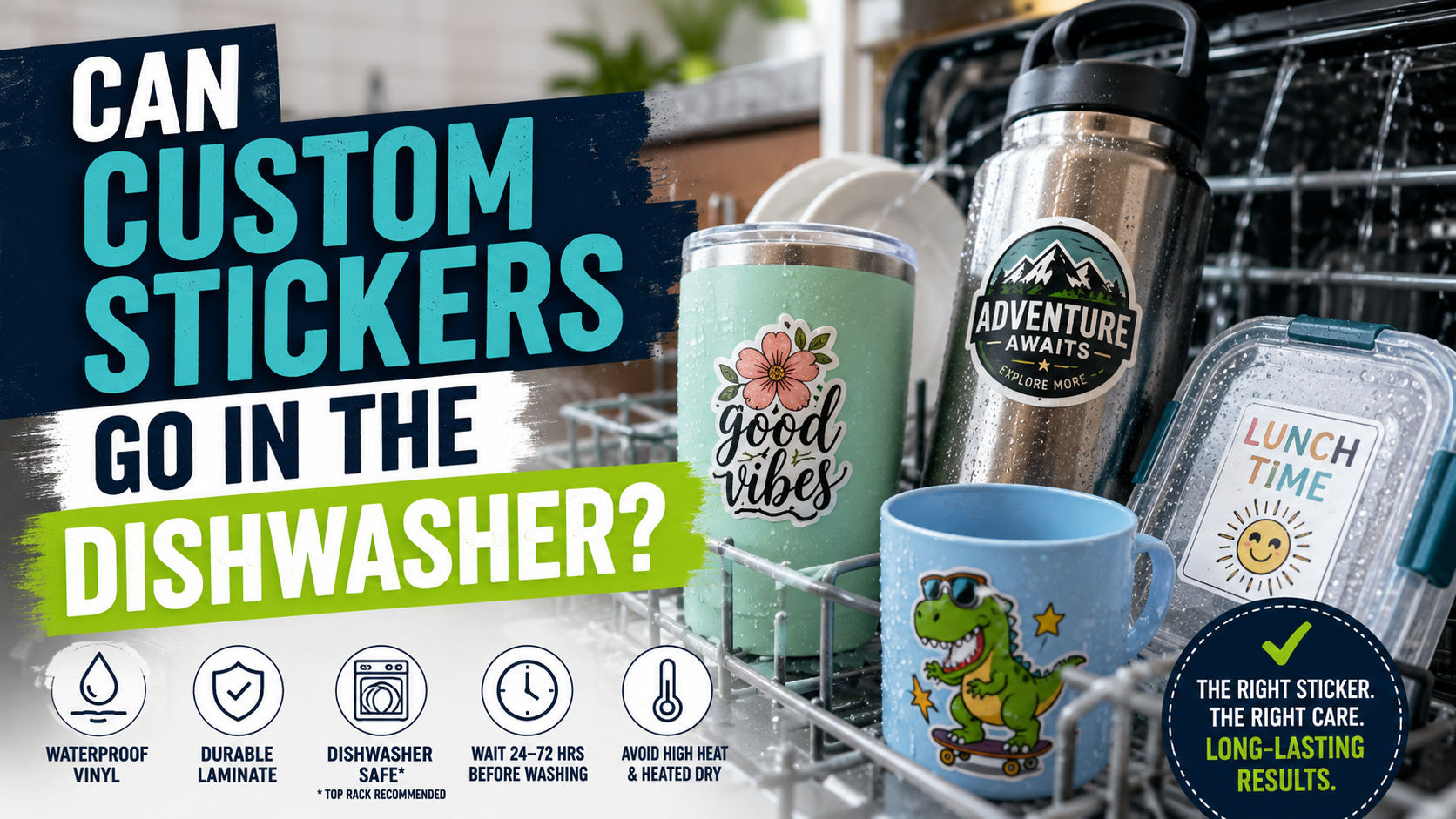
Yes, well-made custom stickers can survive the dishwasher. Laminated vinyl stickers perform much better than paper stickers because the vinyl resists water and the laminate protects the printed design.
For the best results:
- Use laminated vinyl stickers.
- Apply them to a clean, smooth, dry surface.
- Wait at least 24 hours before washing, and preferably 48 to 72 hours.
- Keep stickers away from seams, rims, handles, and sharp curves.
- Use the top rack and skip heated drying when possible.
- Hand wash items when you want the sticker to last as long as possible.
A sticker can survive dozens of dishwasher cycles and still not be permanently dishwasher-proof. Heat, detergent, water pressure, surface type, and daily handling all affect its lifespan.
A water bottle sticker may look perfectly fine after one trip through the dishwasher. That does not necessarily mean it will look the same after a year of daily washing.
But the opposite is also true. A good laminated vinyl sticker is not automatically doomed the moment it enters the dishwasher. The right sticker, applied correctly, can hold up surprisingly well.
CustomStickers.com makes its waterproof stickers from durable vinyl with a protective laminate, and the company rates them for dishwasher use on items such as water bottles and tumblers.
Still, “dishwasher safe” needs some context. A normal wash on the top rack is different from a sanitize cycle beside a heating element. A smooth stainless steel bottle is different from a flexible polypropylene lunch container. And a sticker that cured for three days will usually have a better chance than one applied ten minutes before the wash cycle started.
Here is what actually determines whether a custom sticker survives.
Vinyl Is Better Than Paper
The sticker material is the first thing to check.
Paper stickers are suitable for boxes, envelopes, notebooks, dry packaging, and other indoor uses. They are not a good choice for items that will be soaked, scrubbed, or washed repeatedly.
Paper absorbs moisture. Even when the printed surface has a clear coating, water may enter through the cut edges. The paper can swell, wrinkle, soften, or separate from the adhesive.
Vinyl does not absorb water in the same way. It provides a flexible plastic base that can handle spills, condensation, rain, and washing much better than paper.
That does not mean every product marketed as a vinyl sticker will perform equally well. Printable craft vinyl, uncoated vinyl, and professionally printed laminated vinyl are different products. For dishwasher use, choose a sticker made specifically for wet or outdoor environments.
The practical rule is simple:
- Paper stickers: Keep them dry.
- Unlaminated vinyl stickers: Fine for light moisture, but durability varies.
- Laminated vinyl stickers: The strongest general choice for dishwasher use.
Laminate Protects the Printed Design
Vinyl helps protect the body of the sticker. Laminate protects what you actually see.
A clear laminate is applied over the printed surface. It creates a barrier between the ink and the outside environment. This helps protect the design from:
- Water
- Detergent
- Scratches
- Rubbing
- Sunlight
- General handling
Without laminate, the vinyl itself may remain intact while the printed image fades, scratches, or wears away. A sticker can technically remain attached while looking rough enough that you wish it had fallen off.
Laminate also adds some thickness and structure. That can help prevent minor scuffs when bottles and containers bump against racks, utensils, or other dishes.
But laminate does not seal every possible entry point forever. The sides of a die-cut sticker are still exposed. If an edge begins lifting, water and detergent can work their way underneath it. Once that starts, repeated cycles may gradually expand the lifted area.
This is why good placement and proper application matter almost as much as the sticker material.
Give the Adhesive Time to Cure
A sticker may feel firmly attached as soon as you press it down. The adhesive may still need time to reach its strongest bond.
Pressure-sensitive adhesive flows into tiny surface irregularities after application. General Formulations notes that complete adhesive wet-out commonly requires at least 24 hours at room temperature, while some manufacturers use a 72-hour dwell time to represent a more complete long-term bond.
For dishwasher use, follow this schedule:
- Minimum: Wait 24 hours.
- Better: Wait 48 hours.
- Safest general recommendation: Wait 72 hours.
Keep the item dry during that period. Do not fill it with ice water, leave it in a humid sink, or run it through a quick wash to “test” it.
Applying firm, even pressure also helps. Press from the center toward the edges and spend extra time around the sticker’s perimeter. The goal is full contact without trapped air pockets.
A sticker applied in a hurry and washed immediately has not been given a fair trial.
Clean and Dry the Surface First
Adhesive cannot make a reliable bond through grease, dust, soap residue, condensation, or hand lotion.
Before applying the sticker:
- Wash the item to remove dirt and manufacturing residue.
- Rinse away all soap.
- Dry it completely.
- Apply the sticker at room temperature.
- Press firmly across the entire design.
- Leave it alone for 24 to 72 hours.
For compatible surfaces, a light wipe with isopropyl alcohol can remove oils that ordinary washing leaves behind. Check the item manufacturer’s care instructions first because alcohol can affect some printed finishes, paints, and plastics.
Do not apply a sticker to a cold bottle pulled directly from the refrigerator. Condensation may form before or during application, even when the surface initially appears dry.
Dishwasher Water Is Hotter Than Hand-Washing Water
Dishwasher heat is one of the main reasons repeated washing is harder on stickers than occasional splashes.
GE states that water entering a residential dishwasher should generally be between 120°F and 150°F. Some high-temperature settings raise wash water to around 140°F.
The sticker is also exposed to that heat for much longer than it would be during a quick hand wash.
Warmth can make some adhesives softer. At the same time, the sticker and the container beneath it may expand at slightly different rates. Repeated heating and cooling can place stress on the sticker edges.
A standard or eco cycle is generally easier on stickers than:
- Sanitize cycles
- High-temperature washes
- Heavy-duty pot cycles
- Extra-long cycles
- Heated drying
One hot wash probably will not destroy a good sticker. But daily high-temperature washing is a much tougher test than occasional top-rack cleaning.
Dishwasher Detergent Is More Aggressive Than Dish Soap
Dishwasher detergent is designed to remove dried food, grease, starch, and protein without hand scrubbing. It is not simply a low-foam version of liquid dish soap.
Automatic dishwasher detergents commonly use alkaline buffers, water softeners, surfactants, enzymes, and related cleaning ingredients. The American Cleaning Institute describes alkaline buffers and water softeners as important parts of automatic dishwasher detergent formulations.
That cleaning chemistry is useful for plates. It is less friendly to adhesives, printed coatings, and exposed sticker edges.
A durable laminate helps shield the ink. But detergent can still attack the bond if it reaches underneath the sticker.
Using more detergent than the machine or detergent manufacturer recommends will not help the sticker. It may also leave residue on the dishes. Use the correct amount for the load, water hardness, and dishwasher.
And never use hand-washing liquid in an automatic dishwasher. The mountain of foam will be memorable, but not in a good way.
Heated Drying Adds More Stress
A dishwasher may finish washing and then expose the sticker to additional heat during drying.
GE explains that its Heated Dry option activates a heater and can add around 30 minutes or more to the cycle. Natural or energy-saving drying turns off that heater and allows the dishes to air dry instead.
Heat drying can contribute to:
- Adhesive softening
- Edge lifting
- Shrinkage
- Curling
- Stress between the sticker and container
- Damage to heat-sensitive plastic items
Turning off Heated Dry will not guarantee that a sticker lasts forever. But it removes one source of repeated stress.
For the longest sticker life, open the dishwasher after the final rinse and let the item air dry. This is especially helpful for plastic lunch containers and children’s cups.
Placement Can Decide Whether the Sticker Survives
A great sticker applied in the wrong place may fail faster than an average sticker in a protected area.
Choose a smooth, relatively flat surface. Avoid placing the sticker:
- Across a seam
- Directly over a sharp curve
- On a textured grip
- Beside the bottom edge
- Under a handle
- Near a lid thread
- Over a flexible hinge
- Where it rubs against a cup holder
- Where fingers constantly pick at the edge
Rounded sticker corners are generally more resistant to lifting than sharp points. Narrow tips and detailed cutouts provide more exposed edges where water can begin working underneath the adhesive.
On a tapered tumbler, place the sticker where the curve is least severe. A large sticker may wrinkle or bridge across the surface instead of making full contact.
Also leave some room around the sticker. A design placed directly against the bottom rim will face more contact with counters, dishwasher racks, and pooled water.
Surviving Washes Is Not the Same as Being Permanently Dishwasher-Proof
These terms are often treated as if they mean the same thing:
- Water-resistant
- Waterproof
- Dishwasher safe
- Dishwasher-proof
They describe different levels of exposure.
A water-resistant sticker may survive splashes, condensation, and short contact with water.
A waterproof sticker uses materials that are not easily damaged by water. Laminated vinyl is the common example.
A dishwasher-safe sticker is intended to withstand the combined effects of water, heat, detergent, and spray during normal dishwasher cycles.
A permanently dishwasher-proof sticker would need to survive every cycle indefinitely, regardless of the dishwasher, detergent, surface, placement, or drying setting.
That final promise is not realistic for a pressure-sensitive sticker. All materials age. Adhesives lose strength, laminate becomes scratched, containers flex, and exposed edges take damage.
A quality sticker may last through many regular washes. But the precise lifespan depends on the full setup. This is a practical conclusion based on the known effects of surface type, heat, chemical exposure, cure time, and adhesive selection.
For branded merchandise or products sold to customers, it is better to say that the stickers are designed for dishwasher use rather than promising that they can never peel.
Recommendations by Item Type
| Item | Best Sticker Choice | Placement | Washing Recommendation |
|---|---|---|---|
| Stainless steel water bottle | Laminated vinyl | Smooth center area away from bottom rim | Top rack, normal cycle, air dry when possible |
| Insulated tumbler | Laminated vinyl with rounded corners | Flattest part of the body, away from grips and taper | Follow the tumbler maker’s instructions; hand wash for longest life |
| Plastic lunch container | Laminated vinyl with a simple shape | Flat lid or rigid side panel | Top rack only; avoid flexible hinges and heated dry |
| Children’s cup | Laminated vinyl with rounded edges | Smooth exterior away from rim, handle, and mouth area | Top rack or hand wash; inspect regularly for lifting |
Best Stickers for Water Bottles
Water bottles are one of the easiest dishwasher sticker applications because many have smooth, rigid surfaces.
Stainless steel usually provides a strong application surface when it is clean and dry. Painted and powder-coated bottles can also work well, although texture and coating quality vary.
Place the sticker on the middle portion of the bottle. Avoid the bottom edge, where it will rub against tables and dishwasher racks. Also avoid severe curves near the neck.
For a bottle washed once or twice a week, laminated vinyl should have a good chance of lasting. For a bottle washed daily on a sanitize cycle, some gradual wear should be expected.
Best Stickers for Tumblers
Tumblers create two separate questions:
- Can the sticker go in the dishwasher?
- Can the tumbler itself go in the dishwasher?
Some vacuum-insulated tumblers are dishwasher safe. Others are labeled for hand washing because of their coating, seal, insulation, or printed design. Follow the manufacturer’s instructions for the tumbler first.
Use a medium-sized sticker rather than wrapping a large design around a tapered cup. Place it away from the most common grip area when possible.
Even when both the tumbler and sticker are dishwasher safe, hand washing is still the gentler choice.
Best Stickers for Lunch Containers
Lunch containers are more unpredictable because many are made from polypropylene or polyethylene. Avery Dennison identifies these as low-surface-energy plastics that can be difficult for ordinary adhesives to bond to securely.
A sticker may adhere well to one plastic container and lift quickly from another that looks almost identical.
For better results:
- Test one sticker before labeling an entire set.
- Choose a larger design with rounded corners.
- Place it on a rigid, flat section.
- Avoid hinges, clips, textured areas, and flexible walls.
- Wait 72 hours before the first wash.
- Use the top rack.
If the container flexes every time the lid is opened, keep the sticker away from that stress point.
Best Stickers for Children’s Cups
Children’s cups tend to be washed often, dropped frequently, and handled around the edges. That makes placement especially important.
Use a laminated vinyl sticker with a simple shape and rounded perimeter. Place it on the smooth exterior of the cup, well below the drinking rim and away from straw openings, mouthpieces, handles, and lid threads.
Check the sticker periodically. Remove it when an edge begins lifting enough that a child can pick at or chew it.
For daycare or school name labels, a small sticker may be useful, but make sure the text is large enough to remain readable after repeated washing. Hand washing will usually extend its life.
How to Make Dishwasher Stickers Last Longer
Use this checklist before the first wash:
- Start with professionally printed laminated vinyl.
- Confirm that the cup or container itself is dishwasher safe.
- Choose a smooth, rigid section of the item.
- Clean and dry the surface completely.
- Apply the sticker at room temperature.
- Press firmly, especially around the edges.
- Wait 48 to 72 hours.
- Load the item on the top rack.
- Use a normal or eco cycle.
- Turn off sanitize and heated dry when practical.
- Inspect the sticker occasionally.
- Hand wash when maximum lifespan matters.
The biggest improvements usually come from using the right material, waiting for the adhesive to cure, and avoiding harsh cycles.
Frequently Asked Questions
Can Vinyl Stickers Go in the Dishwasher?
Yes, but laminated vinyl is a better choice than unlaminated vinyl. The laminate protects the printed image from detergent, water, scratches, and handling.
How Long Should I Wait Before Washing a New Sticker?
Wait at least 24 hours. A 48- to 72-hour curing period gives the pressure-sensitive adhesive more time to form a complete bond.
Should Stickered Water Bottles Go on the Top Rack?
Yes. The top rack generally keeps the item farther from exposed heating elements and reduces some of the heat stress associated with the bottom rack.
Will Heated Dry Ruin a Sticker?
Not necessarily, but repeated heated drying can shorten the sticker’s life. Air drying or using an energy-saving dry setting is gentler.
Why Did My Sticker Peel Off a Plastic Container?
The container may be made from a low-surface-energy plastic such as polypropylene or polyethylene. These plastics are harder for standard adhesives to bond to. Surface texture, flexing, residue, and insufficient curing time can also cause peeling.
Are Custom Stickers Permanently Dishwasher-Proof?
No sticker should be treated as permanent under every possible dishwasher condition. A quality laminated vinyl sticker can survive repeated normal washes, but its lifespan will still depend on heat, detergent, placement, surface material, and handling.
The Bottom Line
Custom stickers can go in the dishwasher when they are made from durable vinyl, protected with laminate, and applied correctly.
But the sticker is only one part of the equation. A smooth surface, firm application, adequate curing time, moderate water temperature, sensible detergent use, careful placement, and gentler drying all improve the odds.
For water bottles and stainless tumblers, laminated vinyl is usually a strong choice. Lunch containers and children’s cups require more testing because their plastics may be harder to bond to and may flex during use.
And when you want a sticker to last as long as possible, hand washing still wins. It is not exciting advice, but it works.