
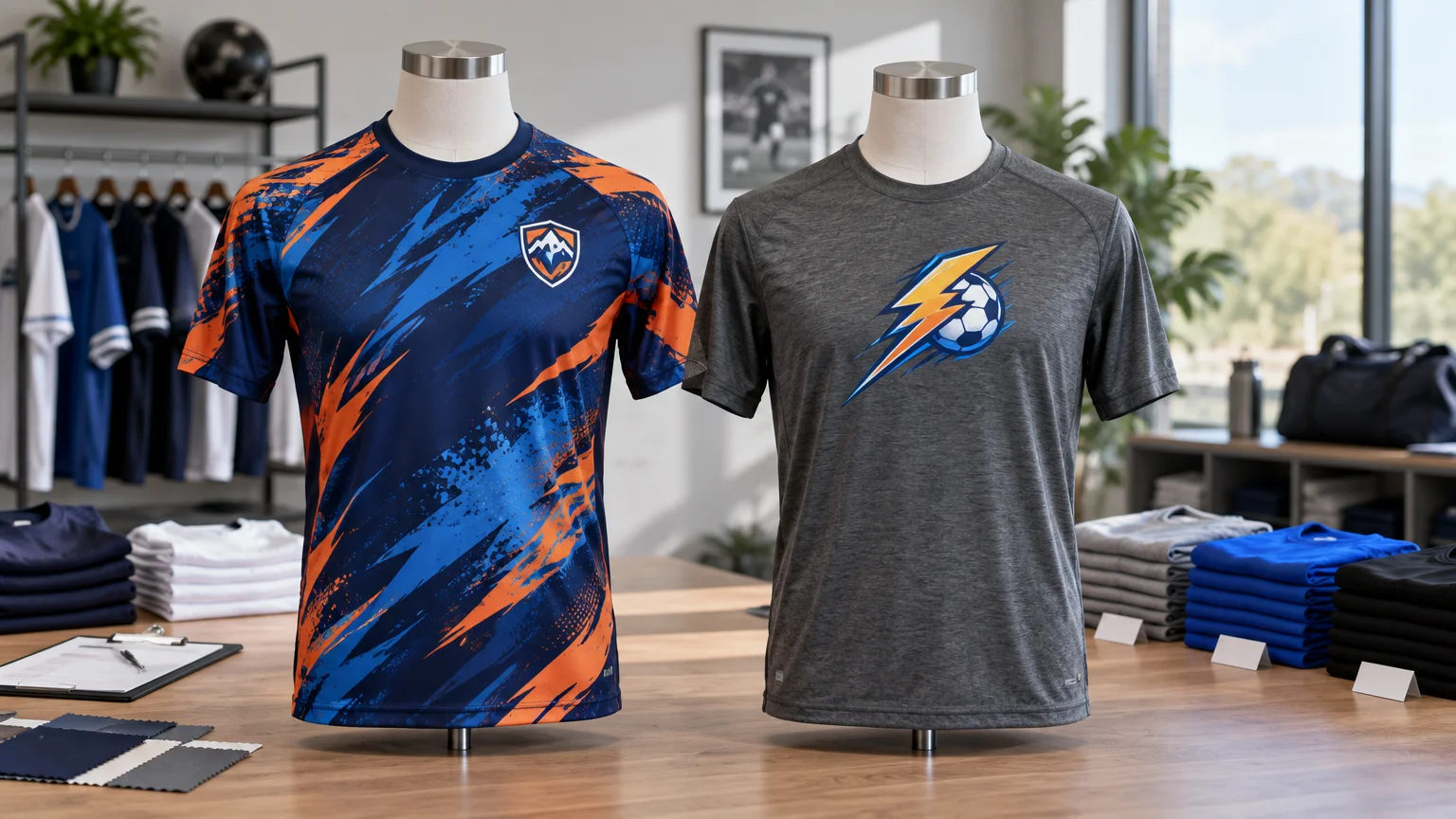
TLDR: When comparing sublimation vs dtf performance uniforms, choose sublimation for a purpose-built polyester uniform with integrated artwork, especially when the design spans large areas or multiple panels. Choose direct-to-film, or DTF, when you want to decorate stocked performance garments with placed logos, names, numbers, or other graphics while keeping small additions and replacement orders practical. Neither method is automatically best: the garment, artwork coverage, wearer comfort, roster stability, and reorder model should decide.
A team ordering coordinated game jerseys has a different problem from a gym replacing three staff shirts. The first may need colors, sponsors, numbers, and patterns incorporated throughout the uniform. The second may need a small chest logo applied to readily available performance tees. Start with that operating difference rather than comparing print samples in isolation.
Sublimation vs DTF performance uniforms at a glance
| Decision factor | Sublimation | DTF |
|---|---|---|
| Typical garment fit | Polyester or a suitable polymer-coated substrate; verify the exact product | Potentially suitable for cotton, polyester, blends, and tri-blends when allowed by the selected transfer system |
| Garment color | Traditional sublimation is generally planned around white or light compatible substrates | Can provide an opaque placed graphic on light or dark garments, subject to transfer and garment testing |
| Artwork coverage | Well suited to integrated designs and potentially broad panel coverage in a purpose-built uniform program | Best suited to defined transfer placements such as a chest logo, back graphic, name, or number |
| Hand feel | The image becomes part of a compatible substrate rather than forming a separate applied graphic layer | Creates an applied transfer layer whose feel depends on its size, artwork, material, and application |
| Personalization | Can incorporate each player’s name and number when the production workflow supports variable art | Practical for adding individual names, numbers, roles, or sponsor marks to stock garments |
| Small additions | Depends on the supplier’s custom-uniform workflow and minimums | Often operationally convenient for late additions, provided the blank and transfer remain available |
| Reorders | Requires control of garment construction, color, artwork, and supplier specifications | Requires the same blank, transfer file, dimensions, placement, and application process |
| Durability decision | Validate the exact substrate, inks, manufacturing process, and care conditions | Validate the exact transfer, garment dyes, press settings, coverage, and care conditions |
Start with the garment, not the decoration method
The phrase “performance uniform” does not identify one fabric. It can describe a polyester jersey, a cotton-rich training shirt, a stretch blend, a mesh-panel top, or a moisture-wicking polo. Even garments that look similar can react differently to heat and decoration.
Sawgrass describes its traditional SubliJet sublimation system as intended for polyester textiles and polymer-coated products. That makes fiber content and substrate compatibility foundational rather than optional details. A real product specification illustrates the point: Augusta Sportswear lists its Pinstripe Full-Button Jersey as a 100% polyester, moisture-wicking garment. That specification is useful, but it does not prove that every other performance jersey has the same composition or construction.
DTF can cover a broader range of garment categories, but buyers should not translate that into “works on everything.” STAHLS lists application instructions for its UltraColor MAX DTF transfer on 100% cotton, 100% polyester, cotton/polyester blends, and tri-blends. Its application settings vary by fabric category, which is a reminder that compatibility depends on the selected transfer system and garment rather than the DTF label alone.
Before choosing, record the garment manufacturer, style number, fiber composition, garment color, panel or mesh construction, stretch areas, and any heat restrictions. For dark or heavily dyed polyester, request testing for color migration or other visible changes. If the uniform is flame-resistant, arc-rated, high-visibility, or otherwise regulated, obtain written decoration guidance from the garment manufacturer before proceeding.
Where sublimation has the advantage
On a compatible substrate, sublimation turns the design into part of the substrate instead of leaving a separate applied graphic layer. For active uniforms, that makes it attractive when broad artwork coverage and a minimally noticeable decorated area are important.
Sublimation is often the stronger design system for a coordinated jersey rather than merely a way to add a logo. A supplier may be able to incorporate team colors, gradients, side patterns, sponsors, player numbers, and names into the garment’s planned artwork. If the uniform is produced from printed panels, the visual design may extend across larger areas than a conventional placed transfer. Confirm those capabilities with the actual uniform supplier; not every sublimation service provides all-over or cut-and-sew production.
Garment color is the major constraint. Sawgrass guidance distinguishes traditional sublimation around white or light substrates. A buyer should not assume that the same process will place a bright white or opaque light-colored image directly onto an ordinary dark jersey. A dark-looking sublimated uniform may instead begin with light polyester fabric on which the dark background and other colors are printed as part of the overall design.
Sublimation therefore makes the most sense when the uniform is being designed as a complete product. It is less straightforward when a buyer has already selected finished dark polos and only wants to add a small white chest logo.
Where DTF has the advantage
DTF is often the practical choice when the garment comes first and decoration is added afterward. A business can select a stock performance tee or polo and then position a full-color transfer on the chest, sleeve, or back, assuming testing confirms that the garment and transfer are compatible.
This approach can fit programs with changing names, numbers, departments, or sponsor marks. A gym may need two shirts for a new trainer, while an event organizer may not know the final staff count until shortly before production. Working from stock garments and discrete transfers can make those changes easier than reopening a fully customized uniform program. Actual minimum quantities, setup charges, turnaround times, and transfer availability remain supplier-specific.
The tradeoff is that a DTF graphic is an applied layer. A small left-chest logo may be barely relevant to wearer comfort, while a dense transfer covering much of the front or back can be more noticeable. Artwork should therefore be judged by printed area, not just the dimensions of its bounding box. An open design with separated lettering covers less fabric than a solid rectangle of the same overall size.
Care instructions also belong in the decision. STAHLS directs users of its referenced DTF product to machine wash garments inside out with mild detergent, avoid bleach and dry cleaning, and use normal household drying. Treat those instructions as product-specific guidance, and issue the approved instructions for the transfer and garment actually ordered.
How color, detail, and placement change the choice
Both methods can reproduce multicolor artwork, gradients, sponsors, names, and numbers through an appropriate production workflow. The more useful question is where that artwork needs to live.
- Choose a sublimation-led program when patterns, gradients, or team colors need to feel integrated across the jersey body, sleeves, or coordinated panels.
- Consider DTF when the design consists of defined placements on an existing garment, such as a left-chest logo, back sponsor, player name, or staff role.
- Ask for a panel map or production mockup when artwork approaches seams, collars, plackets, mesh zones, or sleeve joins.
- Avoid placing a large transfer across a high-stretch or high-sweat area without testing movement, comfort, and appearance on the actual garment.
- Check the contrast of names and numbers at normal viewing distance. Fine detail that looks impressive on a monitor can be less useful than clear roster identification.
For either method, obtain a proof showing garment color, artwork scale, placement, spelling, roster data, and number assignments. A digital proof checks content and layout. It does not demonstrate fabric behavior, transfer feel, actual color, or the effect of laundering.
Do not declare a universal durability winner
There is not enough information in the method names alone to say that sublimation or DTF will always last longer. Sublimation performance depends on the substrate, inks, heat process, garment construction, exposure, and care. DTF performance depends on the transfer film and adhesive system, application temperature and pressure, garment dyes, artwork coverage, stretch, laundering, and care.
A responsible approval process uses the actual garment and intended decoration. At minimum, inspect a physical sample for color, opacity, edge quality, surface feel, stretch behavior, and any garment discoloration. Then wash it according to the proposed care instructions and inspect it again. Programs with demanding service conditions may need formal testing rather than an informal household wash.
For example, AATCC TM61 is an accelerated laundering colorfastness test method. Its description says a 45-minute test can approximately simulate the color loss and surface changes associated with five hand or home launderings under specified conditions. That does not produce a universal lifespan claim, but it shows why buyers should define a test method and acceptance criteria instead of relying on an unsupported wash-count promise.
Three use cases that make the decision clearer
A stable travel team ordering coordinated jerseys
Suppose a travel team has a confirmed roster and needs polyester jerseys carrying a background pattern, two sponsor marks, player names, and large front and back numbers. The same visual system extends onto the sleeves and side areas.
This is typically a sublimation-oriented use case because the artwork is integral to the uniform rather than confined to one logo position. The buyer should confirm the supplier’s panel coverage, size range, roster process, minimum quantity, replacement-order policy, and expected color matching between production batches.
A gym replacing staff performance shirts as people join
Now consider a gym that uses stock dark performance tees with a small full-color chest logo and a larger back mark. Staff changes throughout the year, and replacements are usually ordered one or two at a time.
DTF is often the more practical starting point because the program is based on stocked garments, placed graphics, and variable quantities. The gym still needs a decorated sample of the exact shirt. Dark polyester can be sensitive to heat and dye-related problems, so a generic sample on cotton is not an adequate approval.
Tournament warm-up shirts with a late roster
A one-event warm-up shirt may have participant names, a tournament graphic, and uncertain quantities. DTF can suit this model when a supplier can source the blank consistently and update variable information without rebuilding a custom garment. Before ordering, compare the transfer coverage and feel against the expected duration and intensity of wear. If the artwork covers most of the shirt, a purpose-built sublimated option may still provide a better overall uniform design.
Build reorders into the first order
The best-looking approval sample does not solve the program if replacements cannot be matched six months later. Whether choosing DTF or sublimation, preserve a production record rather than relying on an email that says “same as last time.” This record can also support the broader process of creating custom uniforms for a small business.
- Garment manufacturer, exact style number, color name, and fiber specification
- Approved artwork files and the color references used by the supplier
- Decoration method, transfer product or sublimation workflow, and supplier
- Finished decoration dimensions and placement measurements from stable garment reference points
- Roster spreadsheet format, capitalization rules, number style, and approved spellings
- A photograph of the approved sample under neutral lighting
- The physical approved sample, when practical
- Approved care instructions distributed to wearers
- Order date, size breakdown, production batch, and notes about substitutions
- The supplier’s policy for minimums, discontinued garments, and one-off replacements
Ask what happens if the original garment is discontinued. A replacement with the same general description may differ in shade, knit texture, stretch, sizing, or heat response. Decide in advance whether a visibly close substitute is acceptable or whether the organization will transition an entire group to a new style.
The practical recommendation
Choose sublimation when you are building a coordinated polyester uniform around integrated artwork and the supplier has confirmed that its substrate and production workflow support the design. It is especially compelling when large-area graphics and a decoration that does not form a separate surface layer matter more than the convenience of using an existing stock garment.
Choose DTF when you need placed graphics on stocked garments, must accommodate multiple fabric categories, or expect small additions and frequent personalization. Keep artwork coverage appropriate for active wear, follow the selected transfer supplier’s application and care requirements, and test the exact performance garment—particularly dark polyester.
Before approving the full order, put one decorated sample through the conditions that matter: movement, stretch, perspiration exposure where relevant, and repeated care. Confirm the roster and preserve the complete production specification. That physical evidence and reorder record will make a more reliable uniform program than any blanket claim that one decoration method is always better.