
TLDR
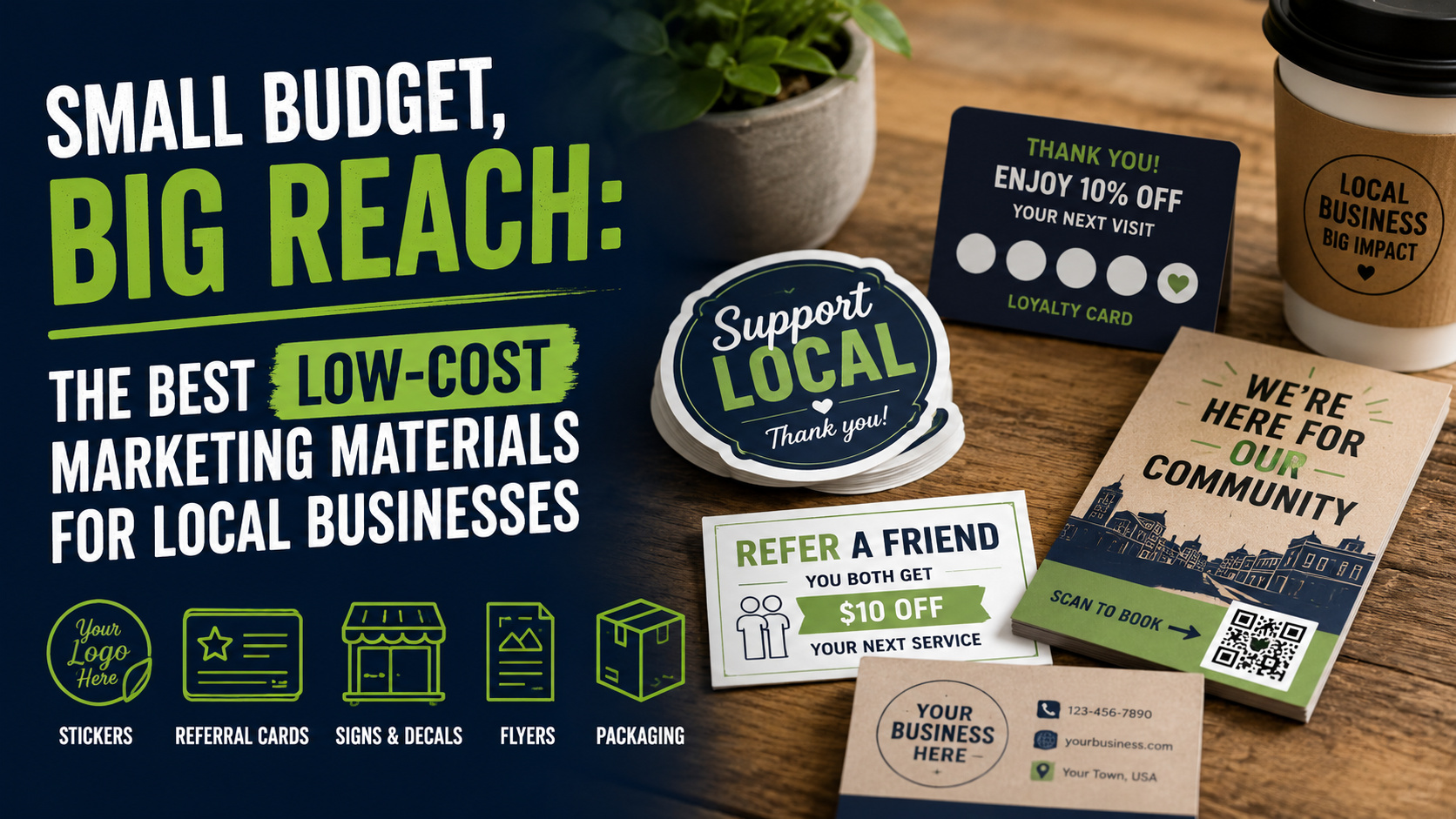
The best low-cost marketing materials for local businesses are useful, easy to distribute, and connected to a clear next step.
- Use custom stickers for giveaways, packaging, equipment, and local events.
- Print referral cards and limited-time offer cards that give people a reason to respond.
- Keep business cards focused on one action, such as calling, booking, or viewing your work.
- Use simple signs, flyers, and QR codes where customers are already paying attention.
- Start with two or three versatile materials instead of ordering a little of everything.
Local businesses rarely need a warehouse full of promotional products. They need a few good materials that can be used repeatedly, handed out naturally, and understood in a few seconds.
That is the main advantage of the best low-cost marketing materials for local businesses. A small sticker, card, sign, or package insert can keep promoting your business after the original conversation ends. The trick is choosing materials with a real job instead of printing something simply because it seems like every business should have it.
What Makes a Marketing Material Worth the Money?
Low cost does not always mean good value. A cheap flyer that sits in a box for three years is still wasted money.
Before ordering anything, ask three questions:
- Where will people see it?
- What should they do after seeing it?
- How many times can the material be used or noticed?
A countertop sign with a booking QR code may be seen hundreds of times. A branded sticker placed on a customer’s water bottle could travel around town for months. A referral card might bring in one new customer and pay for the entire print run.
The best materials connect physical visibility with a simple action. That action might be visiting your website, scanning a menu, following your social account, booking an appointment, claiming an offer, or telling a friend.
1. Custom Stickers
Custom stickers are among the most flexible marketing materials a local business can order. They work for restaurants, contractors, salons, coffee shops, artists, service companies, retailers, and event vendors.
A single design can be used as:
- A customer giveaway
- A package seal
- A shopping bag label
- A product label
- A thank-you extra
- An equipment or tool decal
- An event handout
- A sticker for staff laptops, bottles, or cases
That flexibility is important when the marketing budget is small. You do not need separate materials for every situation.
A simple logo sticker is usually the safest starting point. But a mascot, local phrase, useful illustration, or mildly amusing slogan may be more likely to earn a place on someone’s laptop or water bottle. Customers are more willing to display a design that says something about them, not only something about your business.
You can order durable custom business stickers from CustomStickers.com in shapes and sizes that match your branding. For giveaways, a design around 2.5 to 3 inches is usually large enough to feel substantial without becoming difficult to place. Smaller stickers can work well for product packaging, cups, bags, and mailers.
Keep the design readable. A sticker is not a tiny brochure. Your logo, a short phrase, or one clear image is usually enough.
2. Referral Cards
Referral cards turn word-of-mouth marketing into something customers can easily pass along.
The strongest referral offers reward both people. For example:
- Give a friend $10 off, and receive $10 off your next visit.
- Share this card with a neighbor, and you both receive a free upgrade.
- Refer a new client, and receive a complimentary add-on.
- Bring this card to your first appointment for 15% off.
The offer should be easy to understand without an employee explaining it. Include the business name, the reward, any important restrictions, and a clear redemption method.
You can also add a referral code or small blank line where the existing customer writes their name. That gives you a basic way to track which customers are sending new business.
Referral cards are especially useful for salons, cleaners, landscapers, contractors, tutors, photographers, pet services, fitness studios, and other businesses built around repeat relationships.
3. Business Cards With One Clear Purpose
Business cards still make sense when you regularly meet customers face to face. But they work better when they have a specific purpose.
Do not fill every available inch with services, social icons, certifications, slogans, phone numbers, and a paragraph about your company history. Nobody wants homework from a business card.
Include the essentials:
- Business or employee name
- Short description of the service
- Phone number or email address
- Website or booking page
- One useful QR code
- A clear reason to keep the card
For a home-service business, the card might say, “Save this card for your next plumbing problem.” A photographer could feature one strong image and link directly to a portfolio. A restaurant could use the back for its address, hours, and online ordering code.
Business card stickers are another option. They provide the same contact information in a format customers can place on a toolbox, refrigerator, storage bin, or office cabinet. This can work well for repair companies and other services people may need unexpectedly.
4. Offer Cards and Bounce-Back Coupons
A bounce-back offer gives an existing customer a reason to return.
Unlike broad coupons distributed across town, these cards go to people who have already purchased from you. That makes the audience much more relevant.
Useful offers include:
- A discount on the next purchase
- A free add-on with the next appointment
- A seasonal service reminder
- A discount for returning within 30 days
- A bonus for trying another product or service
Keep the offer modest enough to protect your margins. A free upgrade or small add-on may feel valuable without costing as much as a large percentage discount.
Add an expiration date when a faster return visit matters. But give the customer enough time to use it. A seven-day offer is not very helpful when the service is normally purchased every two months.
5. Flyers for Specific Local Promotions
Flyers can still work, but they need a focused message and a sensible distribution plan.
A generic flyer that says “We offer quality service at affordable prices” will not give people much reason to respond. A stronger flyer promotes something specific:
- A grand opening
- A neighborhood discount
- A seasonal service
- A workshop or class
- A limited-time menu
- A community event
- A free estimate or consultation
- A new customer package
Use a clear headline, one main image, a short explanation, and one call to action. Include the address when location matters. Add a QR code for booking, ordering, directions, or offer redemption.
Distribution matters as much as design. Ask nearby businesses if they have a community board. Include flyers in local orders. Place them at related businesses with permission. Hand them out at an event where the audience already matches your customer base.
Printing 5,000 flyers does not help when you have no sensible place to put them.
6. Window Signs and Door Decals
A storefront window is advertising space you already pay for.
Basic window signs can communicate:
- Business hours
- Walk-ins welcome
- Online ordering
- Gift cards available
- New customer offers
- Seasonal promotions
- Pickup instructions
- Social media information
- Accepted payment methods
Customers should be able to understand the most important message while walking or driving past. Use large type and strong contrast. Avoid turning the window into a wall of small text.
A permanent logo decal can establish the brand, while smaller removable pieces can promote changing offers. This keeps you from replacing the entire display every time a sale ends.
For businesses without a traditional storefront, similar decals can be used on mobile service equipment, display cases, event booths, mirrors, or interior doors.
7. Packaging Stickers and Product Labels
Plain packaging is inexpensive, but it can also look unfinished. A branded sticker or label fixes that without requiring fully custom boxes or bags.
Apply packaging stickers to:
- Paper shopping bags
- Takeout containers
- Bakery boxes
- Tissue paper
- Shipping mailers
- Product jars and bottles
- Sample envelopes
- Thank-you cards
This is especially useful for businesses that sell at farmers markets, craft fairs, pop-ups, festivals, and other local events. The customer may carry the branded package around the event, giving the business more visibility.
Product labels can also communicate practical information such as flavors, scents, sizes, ingredients, care instructions, or batch details. In that case, readability matters more than decoration.
A label should make the product easier to identify and buy. Good branding helps, but it should not bury the useful information.
8. Loyalty Cards
Loyalty cards are simple, familiar, and inexpensive. They work best for businesses where customers naturally return on a regular schedule.
Common examples include:
- Coffee shops
- Bakeries
- Car washes
- Pet groomers
- Nail salons
- Barbershops
- Fitness studios
- Quick-service restaurants
- Children’s activity centers
The reward should feel achievable. Requiring 25 purchases for a minor discount is not much of a loyalty program. It is closer to a long-term administrative project.
A reward after five to ten qualifying purchases is easier to understand. Use a custom stamp, hole punch, initials, or a digital code to reduce casual copying.
Loyalty cards can also encourage customers to try different services. A salon might reward one point for each appointment type, while a bakery could feature a rotating product category.
9. Thank-You Cards and Package Inserts
A thank-you card helps a small business feel personal without requiring the owner to write a separate note for every order.
The message does not need to be long:
Thank you for supporting our local business. We appreciate your order and hope to see you again soon.
The back can include:
- Care instructions
- A reorder link
- A review request
- A referral offer
- Social media information
- A customer service email
- A short description of another product
Include a sticker with the card to make the package feel more complete. Customers may throw away an insert after reading it, but they may keep and use the sticker.
Avoid asking customers to do five things. Pick the next action that matters most.
10. Reusable QR Code Signs
QR codes connect printed materials to pages that can handle more information.
A code might lead to:
- An online menu
- A booking page
- A payment page
- Google Maps directions
- A review page
- An email signup form
- A portfolio
- Current promotions
- Event registration
Place QR codes where people have enough time and space to scan them. A code on a counter sign is usually easier to use than one printed in tiny type on a moving vehicle.
Use dark code elements against a light, plain background. Leave open space around the code, and test it with several phones before printing a large quantity. The guide to QR code stickers explains how size, contrast, and placement affect scannability.
For information that changes frequently, use a redirect or dynamic QR service. That lets you update the destination without replacing the printed sign.
Starter Marketing Kits by Business Type
You do not need all ten materials at once. Start with the pieces that match how customers encounter your business.
| Business Type | Recommended Starter Materials |
|---|---|
| Restaurant or coffee shop | Window sign, loyalty cards, packaging stickers |
| Contractor or home service | Business cards, vehicle or equipment stickers, referral cards |
| Salon or wellness business | Appointment cards, referral cards, loyalty cards |
| Retail store | Window decals, shopping bag stickers, offer cards |
| Farmers market vendor | Product labels, logo stickers, QR payment sign |
| Artist or maker | Branded stickers, thank-you inserts, business cards |
| Photographer or consultant | Portfolio business card, referral card, event flyer |
| Mobile service business | Vehicle branding, business card stickers, booking QR sign |
A new local business can usually begin with three pieces:
- A versatile logo or branded sticker
- A contact or referral card
- A sign with a strong call to action
Use those materials for a few months before ordering several new formats. Pay attention to what customers take, scan, save, or mention.
Common Ways Local Businesses Waste Their Print Budget
The biggest mistake is ordering materials without deciding where they will go.
Other common problems include:
- Printing too much before testing the design
- Using small text that cannot be read at a glance
- Adding QR codes without testing them
- Offering discounts that damage profit margins
- Using different logos, colors, and messages on every item
- Printing temporary information on materials meant to last
- Asking customers to follow too many calls to action
- Choosing novelty products that do not fit the business
Consistency matters. Your flyer, sticker, sign, and business card do not need to look identical, but they should clearly come from the same business.
Use the same logo, a small set of brand colors, consistent fonts, and a similar writing style. That repetition helps customers recognize the business later.
Frequently Asked Questions
What is the cheapest marketing material for a local business?
Simple flyers, business cards, and small stickers are usually among the lowest-cost printed options. The best choice depends on how the material will be distributed. A sticker may offer better long-term value than a flyer because customers can place it on an item they use regularly.
Are custom stickers good for local business marketing?
Yes. Custom stickers can be used as giveaways, packaging seals, product labels, event handouts, or equipment branding. One design can support several parts of a local marketing plan.
Should a business card include a QR code?
A QR code can be useful when it leads to a specific page, such as a booking form, portfolio, menu, or online store. Do not add one simply to fill space. Label the code so customers know what will happen when they scan it.
How many marketing materials should a new business order?
Most new businesses should begin with two or three versatile materials. Test the design, message, and distribution process before placing a large order or adding more products.
Do flyers still work for local businesses?
Flyers can work when they promote a specific offer and are placed where relevant local customers will see them. Generic flyers distributed without a plan are less likely to produce useful results.
How can a business track printed marketing materials?
Use unique coupon codes, QR destinations, referral names, landing pages, or simple “How did you hear about us?” questions. Tracking does not need to be complicated, but every campaign should provide some way to judge whether it worked.
Choose Materials That Have a Job
The best low-cost marketing materials for local businesses are not necessarily the cheapest items on a printer’s product list. They are the materials that fit naturally into customer interactions and continue working after they are handed out.
Start with a clear sticker, card, or sign. Give it one job. Put it somewhere relevant. Then track what happens.
A modest print budget can go a long way when every piece has a purpose.