
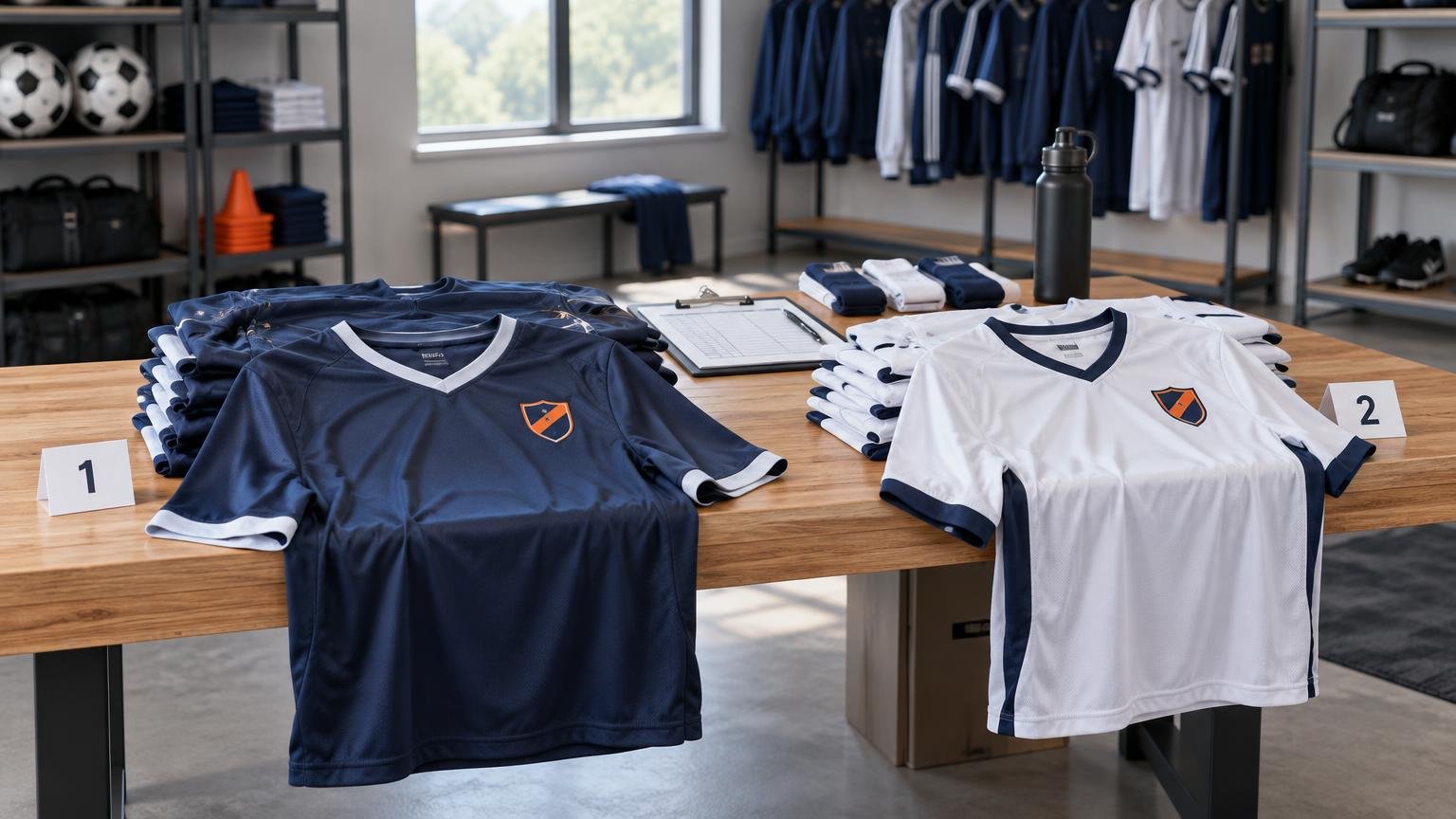
TLDR: Most teams should plan either one game jersey per player when their rules and schedule make color conflicts unlikely, or two contrasting jerseys per player when they need a dependable light-and-dark option. Goalkeepers or other specialized roles must be counted separately. Before ordering, check the governing rules, build a player-level roster sheet, confirm garment-specific sizes, and decide how replacements will be produced.
The practical answer to how many jerseys per player home away planning requires is not automatically two. The correct number depends on the sport, competition rules, opponent colors, who must resolve a clash, and whether the team can use approved pinnies or alternate garments. Treat “home” and “away” as operational labels rather than assuming they carry the same color convention in every league.
For many traveling teams, two clearly contrasting game jerseys per field player provide the most reliable plan. A local recreational team with predictable opponents may be able to use one jersey. The rulebook and schedule should settle that decision before colors, numbers or decoration enter production.
How many jerseys per player home away teams should order
| Situation | Starting plan | What to verify |
|---|---|---|
| One game jersey per player | Potentially workable | The league permits it, opponent colors are predictable, and there is an accepted procedure for resolving clashes. |
| Two contrasting jerseys per player | Reliable general-purpose plan | The two options create obvious visual contrast and both comply with the competition’s markings and numbering rules. |
| Tournament or travel schedule | Usually favor two options | Multiple opponents, venue rules and short intervals between games can make a second color useful. |
| Goalkeepers or specialized roles | Count separately | Their garments may need colors distinct from both teams and officials, depending on the sport’s rules. |
| Practice apparel | Separate from game jerseys | Confirm whether reversible practice jerseys, training shirts or pinnies are needed and who receives them. |
Do not order a second color merely because it is customary, but do not rely on one color because it saves money without first checking the consequences of a clash. A second set can reduce last-minute improvisation, especially when schedules change or tournament opponents are unknown until shortly before play.
Start with the governing rules, not a home-color assumption
Identify the exact governing body for the sport, age group and competition. Check its current rules for team-color contrast, home-team obligations, goalkeeper or specialist colors, numbers, names, logo placements and any restrictions on temporary solutions. Tournament regulations may add requirements beyond the regular league rules.
Soccer illustrates why this matters. IFAB Law 4 says the teams must wear colors that distinguish them from each other and from match officials. Goalkeepers must also be distinguishable from other players and officials. Coaches can review the official IFAB player-equipment law rather than relying on a general home-wears-light convention.
A competition can then assign responsibility for resolving a clash. The NCAA 2026–27 soccer rules provide one specific example: the home team has the initial color choice but must change to a clearly contrasting jersey and stockings when a conflict occurs. Those rules also address distinct goalkeeper jerseys and player numbers. That is a soccer-specific example, not a universal rule for every sport or league.
Ask the league or tournament organizer these questions before approving an order:
- Which team chooses its color first, and which team must change if there is a conflict?
- Is a light-and-dark combination required, recommended or simply customary?
- Can pinnies or bibs resolve a clash during an official game?
- Must shorts and socks also change, or is a contrasting jersey sufficient?
- Do goalkeeper, libero or other specialized positions have separate color rules?
- What number locations, dimensions or uniqueness requirements apply?
- Are sponsor marks, player names or decorative patterns restricted?
Count by role and colorway
Do not calculate the order from roster headcount alone. Divide the roster into roles, determine how many approved colorways each role needs, and calculate each group separately.
Use this basic model: field-player jerseys equal the active field-player roster multiplied by the number of required field-player colorways. Specialized-role jerseys equal the number of players in that role multiplied by their required colorways. Practice garments, staff apparel and approved replacement stock are separate lines rather than hidden inside the game-jersey total.
For example, imagine a roster with 16 field players and two goalkeepers. If every field player needs light and dark jerseys, the field-player order starts at 16 × 2, or 32 jerseys. If each goalkeeper also needs two approved options, add four goalkeeper jerseys, producing a starting total of 36. This is only a calculation example; the actual goalkeeper options and colors must satisfy the applicable rules.
Count jerseys, shorts and socks independently. Two jersey colors do not automatically require two pairs of shorts and two pairs of socks per player. Conversely, a rule may require more than a jersey change to resolve a conflict. Build separate quantities for every garment component instead of treating a “uniform” as one indivisible item.
Decide on replacement stock without guessing a percentage
There is no responsible universal spare-jersey percentage. A team with stable membership, locally stocked garments and fast undecorated replacements faces a different risk from a school program using personalized, seasonal styles with long replenishment times.
Base the spare decision on concrete risks:
- Expected midseason additions or roster turnover
- Likelihood of lost, torn or permanently stained garments
- Supplier stock stability for the exact style, color and size range
- Whether every replacement requires a unique name or number
- Time between games and the decorator’s confirmed reorder process
- Budget and whether unused personalized garments can be reassigned
For numbered uniforms, generic spares are only useful if their numbers can be assigned without violating roster or duplicate-number rules. An undecorated blank can preserve size flexibility, but it still requires compatible decoration and enough production time. Approve replacement quantities as a separate decision after the main roster is accurate.
Build a production-ready roster sheet
A clean roster sheet prevents more mistakes than an informal collection of texts, emails and handwritten notes. Give each wearer one row and each game colorway its own size or confirmation field.
- Player or wearer name
- Playing role
- Approved print name, including spelling and capitalization
- Unique player number
- Garment manufacturer, style or SKU and color
- Fit or cut
- Size for each garment component and colorway
- Decoration locations, colors and method
- Goalkeeper or specialist designation
- Player, coach or organizer approval status
Run a duplicate-number check before releasing the order. Then compare the roster totals with the purchase totals by style, color and size. If the two totals differ, resolve the discrepancy rather than adding an unexplained adjustment.
For a larger roster, use the same structured process described in this guide to building a uniform size run before ordering. It helps separate individual selections, approved spares and final purchasing totals.
Confirm the garment before collecting final sizes
Size labels are not interchangeable across manufacturers, styles or cuts. Select the exact garment first, obtain its current measurement chart, and tell players how measurements should be taken. Account for base layers, protective equipment, mobility and any different fit needed by goalkeepers or other positions.
Garment construction also affects comfort and decoration. As one style-specific example, Champro lists its Show V-Neck soccer jersey with a 100% polyester body, polyester mesh back and sleeves, and adult sizing based on chest and waist body measurements. That specification applies to that garment, not to every jersey.
If possible, use physical samples or a controlled try-on rather than asking players to choose from memory. Record the selected fit as well as the letter size. If the team later changes garment styles, repeat the sizing process instead of transferring old sizes automatically.
Match decoration to the exact jersey
Give the decorator the manufacturer, exact style, color and fiber content for every jersey. Also provide the required number dimensions, print locations, artwork and color targets. A method suitable for one polyester jersey may not produce the same result on another construction or color.
Heat and ink choices matter on saturated polyester. Stahls identifies dye migration—a garment’s dye affecting a heat-applied graphic or plastisol print—as a risk on some polyester and sublimated garments. Ask the decorator to evaluate the actual jersey and color, especially when applying white or light graphics to red, navy, black or other saturated fabric.
Contrast must work in practice, not just on a monitor. Check number and name readability from game distance, and review how the decoration behaves on seams, mesh panels and stretch areas. When a light graphic is being applied to a dark garment, the production considerations in this guide to using an underbase on dark uniform shirts can help frame the proof discussion.
Approve a physical sample when the budget, schedule or risk justifies it. Otherwise, require a proof that clearly identifies the garment color, artwork, number style, dimensions and placements. A proof should be checked against both the roster and the rulebook.
Create a reorder record while the first order is active
A replacement jersey should match the existing set closely enough that it does not look improvised. Save the information needed to reproduce it before files, stock references or staff knowledge disappear.
- Manufacturer, garment name, SKU, fit and color code
- Approved artwork files and color specifications
- Name and number font or artwork
- Number dimensions and every placement measurement
- Decoration method, materials and relevant production notes
- Final roster and assigned-number history
- Proofs, approvals, order date and supplier contact details
Ask what happens if the original jersey is discontinued or a dye lot looks different. A close substitute may still vary in sheen, texture, panel design or shade. When exact visual continuity matters, purchasing planned blanks or decorated replacements with the initial order may be more dependable than assuming the same style will remain available.
Set a season timeline with decision gates
Work backward from the date the complete set must be in hand, not merely the first game. Include time for distribution and correcting a size, number or production error. Obtain current lead-time information from the chosen supplier rather than relying on a generic estimate.
- Confirm the governing rules and game-color plan.
- Select exact garments and verify stock or availability.
- Hold a try-on or collect measurements using the style-specific chart.
- Lock the roster, roles, spellings and assigned numbers.
- Reconcile quantities by style, color and size.
- Approve artwork, decoration details and the final proof.
- Allow time for production, delivery, inspection and distribution.
- Preserve the specifications and establish the midseason reorder contact.
Keep unrelated needs out of the jersey order so they do not obscure critical roster data. If the season also requires signage, handouts or other broader custom printing projects, manage those as separate production lines with their own quantities and deadlines.
Final recommendation
Begin with one jersey per player only when the rules, opponent colors and conflict procedure make that plan genuinely workable. Choose two clearly contrasting jerseys per field player when the team needs a dependable light-and-dark solution across travel, tournaments or uncertain opponents. Count goalkeepers and other specialized roles independently, and do not assume jersey quantities dictate identical shorts or sock quantities.
Before placing the order, verify the rulebook, reconcile every roster row, check duplicate numbers, confirm sizes in the selected style, approve decoration on the actual fabric, and save a complete reorder record. That process—not a universal home-and-away convention—is what turns a roster count into the right team order.