
TLDR
Treat security uniforms as a modular system rather than a one-time shirt order. Choose a daily polo for the actual post, add weather layers that preserve identification, separate ordinary branded visibility from safety-rated high-visibility apparel, and document every garment and decoration detail. Before approving badges, patches, titles, or back lettering, check the rules for the jurisdiction, license category, and client site.
This security staff uniform guide provides a practical framework for building that system. The objective is not to make every employee wear identical clothing in every environment. It is to create controlled options that keep staff comfortable, recognizable, appropriately equipped, and easy to outfit again when people or seasons change.
Build the uniform around the security post
Start with the work environment, not a garment catalog. A front-desk officer in a climate-controlled lobby has different needs from an employee walking an exterior perimeter at night. Event staff may need immediate recognition in a crowd, while parking personnel may also face moving-vehicle exposure.
Document the normal conditions for each post: indoor or outdoor work, shift length, temperature range, rain exposure, walking, bending, radio use, public interaction, traffic exposure, laundering arrangements, and any client dress requirements. Then group posts with similar needs. This prevents an organization from forcing one garment to handle incompatible jobs.
| Post type | Core garment priority | Likely additional layer | Identification priority |
|---|---|---|---|
| Lobby or reception | Polished appearance, comfort and fit | Light sweater, soft shell or blazer-style layer | Clear company and role identification |
| Indoor patrol | Mobility, snag resistance and radio access | Quarter-zip or lightweight jacket | Readable front identification |
| Exterior patrol | Durability, moisture management and layering room | Weather-resistant shell and insulated option | Identification visible on outermost layer |
| Event security | Easy recognition and size flexibility | Packable rain or wind layer | Large, readable role wording where permitted |
| Parking or traffic-adjacent work | Mobility plus hazard-appropriate visibility | Certified high-visibility layer when required | Security identity that remains distinct from safety markings |
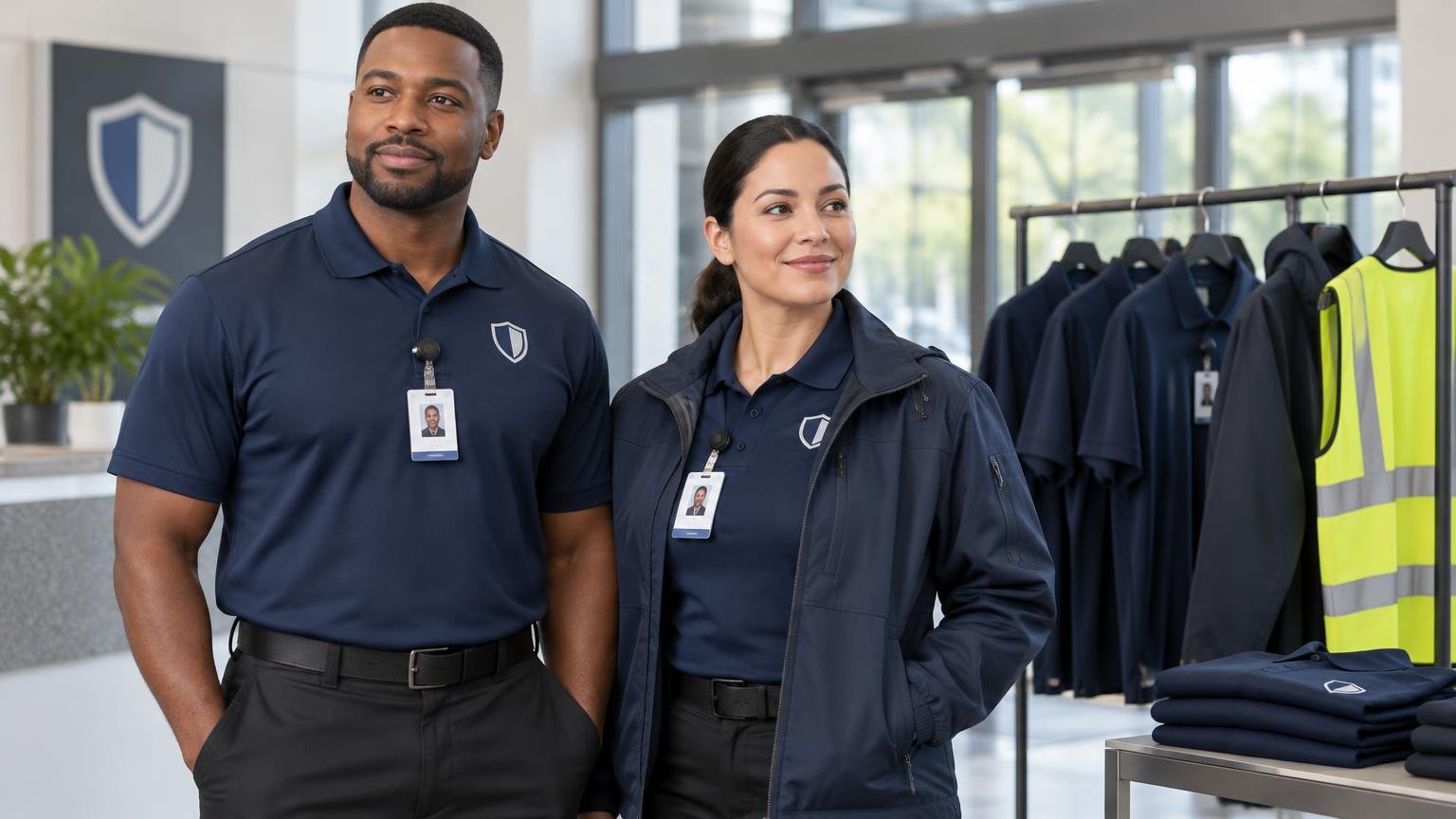
The resulting program might have one core polo color, two approved fits, a lightweight outer layer, a cold-weather layer, and a separate high-visibility option for designated posts. That is still a standardized uniform because the choices are controlled and assigned by role.
Choose an everyday security polo
A security polo should remain comfortable through a long shift while tolerating repeated wear, radio cords, pens, keys, belts, and frequent laundering. Compare fabric composition and weight, snag resistance, mobility, side vents, shirt length, collar construction, pocket placement, size range, and compatibility with required equipment.
Fabric choice should follow the environment. Polyester performance polos may provide moisture-management features and quick drying, while cotton can offer a familiar feel. Blends occupy the middle ground. The practical differences, including decoration and care considerations, are covered in this comparison of polyester and cotton work shirts. Do not select a fabric from the fiber name alone; evaluate the specific garment construction and manufacturer instructions.
Duty-oriented features can be useful, but only if employees will use them. For example, CornerStone lists a tactical polo with snag-proof polyester, mic clips, reinforced sleeve pen pockets, side vents, a drop tail, and an XS–6XL size range. That is a useful feature checklist, not proof that one style fits every team. A reception officer may prefer a cleaner polo without visible utility details, while a mobile patrol employee may value mic attachment points and additional shirt length.
Before standardizing a style, obtain representative sizes and have employees check sleeve movement, seated comfort, shirt length, collar behavior, and interaction with radios or other authorized equipment. Offer a documented fit alternative where possible rather than making employees compensate by choosing an unsuitable size.
Add layers without hiding identification
Outerwear frequently breaks an otherwise consistent program. A well-marked polo becomes irrelevant when an employee puts on an unmarked personal hoodie or rain jacket. Plan approved layers at the same time as the core shirt, even if they will be ordered in a later phase.
A practical system may include a breathable quarter-zip for cool indoor areas, a wind- and water-resistant shell for routine exterior work, and an insulated jacket for cold overnight patrols. Depending on climate and shift conditions, a vest can preserve arm mobility while adding warmth. Confirm that every option allows normal movement and fits over the intended base layers.
Place required identification on the garment employees will actually expose to the public. If a jacket becomes the outermost garment, polo-only identification may no longer be visible. Use an approved layout for every layer, adapting artwork size and technique where necessary. The same stitch count, dimensions, or placement will not automatically work across a polo, fleece, and seam-heavy jacket. A repeatable approach to matching logos across polos and jackets can keep the identity consistent without forcing identical production specifications onto different garments.
Make security identification readable and lawful
Decide what a member of the public, client employee, or supervisor needs to recognize at a glance. Depending on the assignment and local rules, the uniform may identify the employing firm, the security role, the wearer’s name, or a combination of these elements. Readability usually matters more than decorative complexity.
Create a placement map covering the left and right chest, sleeves, upper back, and outerwear. Assign a purpose to each location rather than filling every available area. A company mark might occupy one chest position while a name or role identifier uses the other. Large back wording may help at events or exterior posts, but its wording, size, and use should be approved for the jurisdiction and site.
Private-security rules are not uniform across the United States. Virginia provides one example: its standards address firm identification and last-name identification on the outermost garment for certain uniformed personnel and prohibit uniforms that imply law-enforcement authority. Virginia’s private-security standards explain those state-specific provisions. Michigan separately regulates uniforms, patches, and badges and says private-security dress must not deceive or confuse the public or be identical to local law-enforcement uniforms. These examples demonstrate why copying another organization’s layout is not a compliance strategy.
Before approving artwork, have the responsible compliance contact verify the governing rules for the state and locality, the organization’s license category, the employee’s role, and the client property. Check titles, badge shapes, insignia, patches, nameplates, color combinations, and any required wording. Avoid designs that could create confusion with police or another public agency.
Separate brand visibility from high-visibility protection
A bright logo or reflective-looking trim can make staff easier to notice, but that does not automatically make a garment safety-rated. High-visibility apparel should be selected according to the actual exposure and the specific garment’s documented classification, label, and intended use.
This distinction matters for employees working near public vehicular traffic. OSHA’s work-zone interpretation discusses suitable high-visibility or reflectorized garments for workers exposed to that hazard, while OSHA’s safety management material references ANSI/ISEA 107-2020. The correct response is not simply to print “SECURITY” on a fluorescent shirt. Identify the hazard, determine the applicable site and regulatory requirements, and verify the finished safety garment rather than relying on color or striping alone.
Keep the two functions clear in the uniform matrix. Branding answers “Who does this person represent?” Role wording answers “What function are they performing?” Safety apparel addresses a hazard. One garment may perform all three functions, but each must be specified and verified independently.
Match decoration to the garment
Embroidery often suits small chest logos and names because it creates a durable, dimensional mark. Printing or transfers may be more practical for large back identifiers, detailed artwork, or some low-quantity role variations. The best method depends on the fabric, coating, stretch, artwork, placement, quantity, and care routine—not merely on whether one process is perceived as more premium.
Performance polyester deserves particular attention. A CornerStone specification sheet cautions that polyester performance fabric requires special care during screen printing. Heat-applied processes also require material and application compatibility; STAHLS notes that sublimation uses special inks for polyester garments and advises checking compatibility for heat-transfer applications. Approve the exact combination of garment color, artwork, decoration process, temperature, pressure, and placement before a production run.
Ask for a decorated sample or production-quality approval when ordering a new style. Check logo contrast, fine text, puckering, show-through, dye migration, adhesive edges, placement around seams, and comfort against the body. If choosing between simplified and multicolor artwork, use the decision criteria in one-color versus full-color uniform logos. For embroidery programs, record actual thread references rather than relying on a screen color; this guide to thread color matching for uniform embroidery explains why that matters on future orders.
Plan laundering, issue quantities, and replacement rules
The garment’s care label should guide laundering and drying. The Federal Trade Commission’s Care Labeling Rule requires manufacturers and importers of covered textile apparel to provide regular care instructions and have a reasonable basis for them. Preserve those instructions in the employee uniform policy instead of replacing them with a generic wash routine that may not suit every approved garment.
Issue quantities should reflect shifts between realistic wash opportunities. A simple planning calculation is the number of worked shifts between laundry cycles, plus one ready spare and any operational reserve justified by the post. For example, someone working several consecutive shifts without midweek laundry access needs more polos than an occasional event employee. This is a planning method, not a universal entitlement or fixed industry standard.
The policy should also define who launders each item, whether outerwear is shared, when damaged garments must be removed from service, how replacements are requested, and what happens when an employee changes role or leaves. Shared garments need an identification, inspection, cleaning, and storage process rather than an informal coat rack.
Create an approved uniform matrix
The reorder system is as important as the first order. Record the specifications in one controlled uniform matrix instead of relying on invoices, email threads, or visual memory.
- Role and approved work environment
- Garment brand, style number, color name, and fit option
- Approved size range and the location of the current size chart
- Primary, alternate, and seasonal layers
- Decoration method for each garment
- Artwork file name and revision date
- Finished decoration dimensions and placement measurements
- Thread, ink, or transfer color references
- Approved names, titles, back wording, badges, and patches
- Care instructions and replacement criteria
- Sample or proof approval date
- Supplier, order date, and substitution approval process
Do not permit an unavailable garment to be replaced solely because another item is described as the same color. Compare fabric, shade, weight, collar, pocket configuration, size range, care instructions, and decoration compatibility. If a substitute is necessary, approve it as a new controlled option and retain the previous specification for historical orders.
Preorder checklist
- Map each post’s environment, movement, weather, equipment, visibility, and public-contact needs.
- Verify jurisdictional, licensing, and client-site rules for uniforms, names, titles, badges, patches, and insignia.
- Select the core polo and fit alternatives using current manufacturer specifications.
- Fit-test representative sizes with normal authorized equipment and base layers.
- Choose warm, rain, wind, and high-visibility layers according to actual assignments.
- Confirm that identification remains visible on the outermost garment.
- Approve decoration on the exact garment and color, especially for polyester and coated outerwear.
- Document care instructions, issue quantities, spare stock, and replacement rules.
- Record every garment and decoration specification in the approved uniform matrix.
- Require review before any garment, color, artwork, wording, or production method is substituted.
The practical next step
A reliable security uniform program begins with a post-by-post audit, not a bulk polo quantity. Define the job conditions and identification requirements first, then select a core garment, compatible seasonal layers, and hazard-appropriate visibility apparel. Finish by testing decoration and preserving the approved specifications.
That process produces a uniform system employees can actually wear and managers can reorder consistently. It also makes exceptions visible: if a new client, role, climate, or legal requirement changes the need, the organization can update one documented part of the system instead of improvising an entirely new uniform.
References
- CornerStone Select Snag-Proof Tactical Polo | Product | CornerStone
- 6VAC20-174-150. Standards of conduct.
- Private Security Guard Branch Uniform
- Whether use of high-visibility warning garments by construction workers in highway work zones is required. | Occupational Safety and Health Administration
- OSHA Field Safety and Health Management System (SHMS) Manual – Chapter 8 | Occupational Safety and Health Administration
- CornerStone® Tall Select Snag-Proof Tactical Polo
- Custom Sublimation Heat Transfers – Stahls’
- Care Labeling of Textile Wearing Apparel & Certain Piece Goods | Federal Trade Commission