
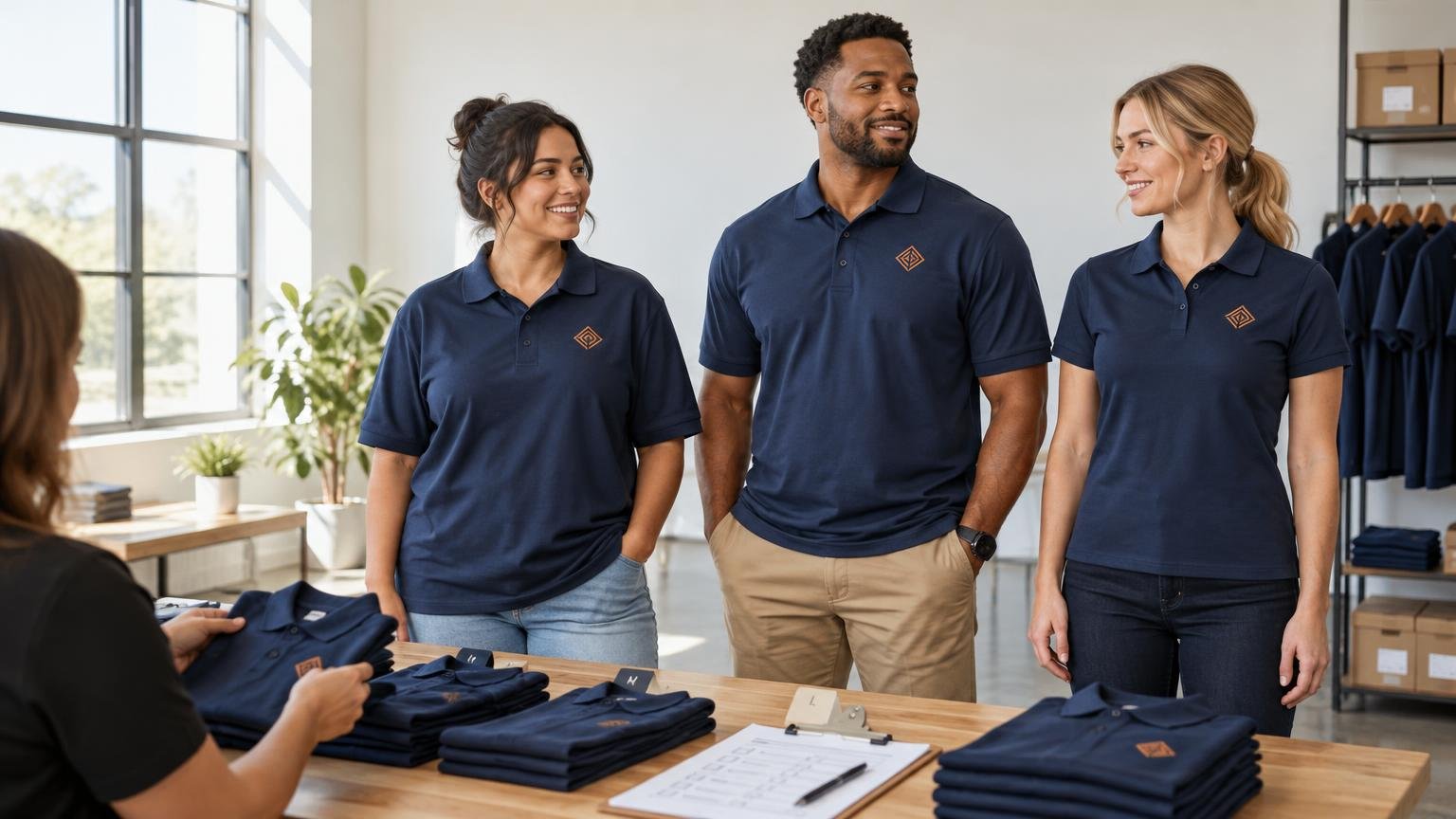
TLDR: A unisex fit can simplify an employee uniform program, but it should not be treated as a universal fit. The most reliable approach is to approve one coordinated garment family with multiple fit options when needed, let employees select from those options, and record the exact manufacturer, style, color, size, decoration, and issue history. Use samples and the size chart for each exact garment rather than converting sizes across fit categories.
For a buyer comparing unisex vs mens womens employee uniforms, the real decision is not which label is universally best. It is how many approved fits the team needs for comfort and size coverage without making purchasing, decoration, and replenishment unnecessarily complicated.
Treat fit selection as an operating system rather than a gender assignment. Lock the garments first, let each employee choose among appropriate approved options, and control every subsequent order through a garment matrix and issue record. That creates room for individual preference while preserving a consistent team appearance.
What unisex, men's, and women's fit labels actually mean
A fit label describes a garment pattern, not the body of every person who might wear it. A unisex shirt often uses a straighter silhouette and may be based on a traditionally men's or shared block. A style labeled women's may have different shaping, proportions, sleeve dimensions, or length. Relaxed and fitted versions can also differ substantially within the same broad category.
These labels do not create a universal size conversion. Manufacturer charts distinguish men's or unisex garments from women's fitted and relaxed garments, and the stated measurement ranges vary by category and style. Some manufacturer resources publish body-size ranges, garment measurements, or both. Buyers should therefore use the chart and measurements for the exact approved SKU rather than assuming, for example, that one women's size always converts to a particular unisex size.
The practical question is whether an approved garment accommodates the employee's measurements, movement, layering, job duties, and fit preference. Employees should be able to select an approved option without a manager assigning a cut based only on perceived gender.
When a unisex-only program is practical
A unisex-only program can work well when the selected garment has broad size coverage, employees can find acceptable sizes through a try-on process, and the job does not require a more tailored silhouette. It can reduce the number of SKUs, samples, proofs, and spare-stock categories the buyer must manage.
That administrative simplicity is useful, but it is not enough on its own. A unisex-only program is a weak choice if the approved garment is consistently too long, too broad, too narrow, or otherwise unsuitable for a meaningful part of the team. Poor fit can also affect how a logo sits on the body, whether an employee can move comfortably, and whether a shirt remains tucked or layered as intended.
When to offer multiple approved fits
A mixed-fit program is usually more practical when the workforce has varied body proportions, the uniform is worn for long shifts, or appearance standards call for both straight and shaped silhouettes. The goal is not to create separate uniforms for separate groups. It is to offer coordinated paths to the same approved appearance.
- Offer multiple fits when one style does not provide adequate size coverage or acceptable proportions for the team.
- Keep the garment color visually consistent by approving exact manufacturer color names and SKUs rather than ordering by a generic term such as navy.
- Use the same approved artwork version, decoration method, thread or ink colors, and nominal placement across the garment family.
- Check placement on every fit and size range. A fixed distance that looks balanced on one cut may sit awkwardly near a seam, placket, pocket, or curve on another.
- Limit the menu to meaningful choices. Two coordinated fits are easier to manage than an open catalog of employee-selected garments.
Visual consistency comes from controlled specifications, not from forcing everyone into the same pattern. Before ordering, decide whether the uniform needs a front identifier, distant recognition, or both; the guide to front versus back logos on employee uniforms explains how that affects placement. If garment fabrics differ between approved fits, confirm that the chosen decoration process produces a comparable result on each one.
Use samples and exact size charts together
A chart is useful for narrowing the likely size, while a sample reveals sleeve movement, torso length, shoulder position, layering clearance, and wearer preference. For an initial program or a large group, use both whenever practical.
- Approve the exact manufacturer, SKU, color, and fit options before collecting sizes.
- Obtain representative samples across the likely size range. Include each approved fit rather than assuming one sample predicts another.
- Give employees a private way to compare their measurements with the exact SKU chart and try on likely sizes.
- Have each employee confirm the selected SKU, fit, and size in writing or through a controlled form.
- Separate unresolved selections, special sizing needs, and accommodation requests from the clean order totals. Route sensitive matters through the appropriate HR process.
- Freeze the employee list at a stated cutoff, total each SKU and size, and obtain purchasing approval before decoration begins.
Do not collect a generic size such as “medium” and choose the garment later. A medium in one fit or SKU may not correspond to a medium in another. For a detailed method of turning individual selections into order totals, see the uniform size-run planning workflow.
Build a garment matrix before requesting a quote
The garment matrix is the controlled specification for the program. It should identify what can be ordered, how it must be decorated, and what can replace it if the primary style becomes unavailable.
| Field | What to record | Why it matters |
|---|---|---|
| Garment | Manufacturer, exact SKU, fit label, and product description | Prevents a similar-looking style from being substituted without review |
| Color | Manufacturer color name and any relevant color code | Generic color names can hide visible differences between garments |
| Sizing | Available range, chart version or URL, and measurement type | Keeps employee selections tied to the correct style |
| Construction and care | Published fabric, care instructions, and job-relevant features | Helps buyers assess laundering, comfort, and role suitability |
| Decoration | Method, location, dimensions, colors, and production notes | Keeps logos consistent across fits and reorders |
| Artwork | Approved file name and version | Stops outdated artwork from returning on a later order |
| Status | Primary or backup, approval date, and last availability check | Makes discontinuation and substitution decisions traceable |
| Proof record | Approved proof, approver, and approval date | Establishes what production was authorized |
If the program uses printed shirts, decoration choice should be part of this matrix rather than decided separately on each purchase. For example, DTG and DTF for employee shirts can differ in garment compatibility and reorder workflow. Fabric choice also affects comfort, care, and decoration, so compare the actual specifications when deciding between polyester and cotton work shirts.
Set quantities from wear and laundry needs
There is no responsible universal number of uniforms per employee. A workable issue quantity depends on how often the garment is worn, how frequently employees can launder it, whether the employer controls laundering, how quickly soiled garments must be changed, and how long replacements take to arrive.
Start with the number of garments an employee needs to move through a normal wear-and-laundry cycle without rewearing an unsuitable item. Then assess role-specific exposure to stains, damage, weather, and shift changes. A kitchen employee, outdoor technician, front-desk worker, and occasional-event employee may require different quantities even when they share the same visual identity.
Document the reason for each allocation instead of relying on habit. The issue standard might vary by role, employment status, season, or laundering arrangement. When circumstances change, the buyer can update the rule without reconstructing the entire order from memory.
Plan spare stock intentionally
Spare uniforms support new hires, size exchanges, damage replacements, unexpected staffing changes, and seasonal demand. The appropriate reserve depends on hiring patterns, turnover, replacement lead time, available storage, and whether the garment is likely to remain available.
Separate spare inventory into three categories. Blank stock is flexible and can be decorated when the employee and size are known. Pre-decorated stock is faster to issue but ties cash to specific logos, locations, and sizes. Personalized stock has the least flexibility and is usually best produced after the recipient's details are confirmed.
Review actual issue and exchange records before each replenishment. If certain sizes move frequently, stock those deliberately. Avoid buying an even quantity of every size merely because it makes the order look balanced.
Use a controlled approval chain
A good approval sequence prevents a purchasing decision from silently changing during production. Assign one accountable person to each stage, even if a smaller organization gives several stages to the same manager.
- Operations approves job requirements, fit options, colors, and garment features.
- Employees or managers confirm individual fit and size selections.
- The brand owner approves the current artwork, decoration colors, dimensions, and placements.
- The decorator supplies a proof for review against the garment matrix.
- A fit or decorated production sample is approved when placement, fabric, or garment variation creates meaningful uncertainty.
- Purchasing approves the final SKU-by-size totals, spare quantities, personalization data, and cost.
- Receiving checks cartons against the purchase order before garments are issued.
- The issuer records what each employee received, exchanged, returned, or replaced.
Treat any proposed substitution as a new approval, not a routine purchasing convenience. Check fit, shade, fabric, care, size coverage, decoration behavior, and price before authorizing it. A garment that appears equivalent in a catalog may create a visible mismatch or require a different decoration setup.
Standardize onboarding, exchanges, and replacements
New hires should pass through the same controlled process as the initial team. Show them the approved fit options, provide the exact charts or samples, collect their selections, confirm personalization details, issue the garments, and update the employee record. Do not let urgent onboarding create an undocumented alternate uniform.
For an exchange, record both sides of the transaction: what came back and what was issued. For a replacement, note the reason, because repeated damage or staining may indicate that the garment, quantity allocation, or laundering process is wrong for the role. When an employee changes location or duties, reassess the kit instead of copying the old assignment automatically.
Keep records at three levels
- Program record: approved garments, backup styles, colors, decoration specifications, artwork versions, proofs, vendors, approval dates, and change history.
- Employee issue record: selected fit, SKU, size, quantities issued, dates, exchanges, replacements, returns, and role or location where operationally relevant.
- Inventory record: blank, decorated, and personalized stock by exact SKU, color, size, location, and status, plus open purchase orders and reserved items.
Keep sensitive accommodation information in the appropriate HR-controlled system rather than embedding medical, religious, or other private details in a general apparel spreadsheet. The uniform record generally needs only the approved operational outcome.
Dress codes are permitted, but the EEOC cautions that employment policies can create discrimination concerns if they treat protected groups less favorably, are enforced unevenly, or do not appropriately address religious or disability accommodation requests. Buyers can review the EEOC's employment policy guidance and route organization-specific questions to qualified HR or legal personnel.
Know when a uniform is also PPE
An ordinary branded polo is not automatically personal protective equipment. When clothing is selected to reduce exposure to a workplace hazard, the safety requirements take priority over branding or silhouette preferences. OSHA identifies selection, use, maintenance, training, and monitoring as elements of a PPE program and states that required PPE must properly fit each affected employee. Consult the OSHA personal protective equipment overview when evaluating a safety-related garment.
Some regulated exposure situations also change who may launder the clothing. OSHA enforcement guidance states that protective uniforms or laboratory coats used as PPE for bloodborne-pathogen exposure must be employer-provided and employer-laundered rather than sent home for cleaning. Safety staff should determine whether a garment is PPE and which current rules apply; the apparel buyer should not make that classification from the garment's appearance alone.
A repeatable buyer checklist
- Define the work, laundering, safety, and appearance requirements.
- Approve a small, coordinated set of exact garments and fit options.
- Confirm size coverage with SKU-specific charts, measurements, and samples.
- Let employees select from approved fits without gender-based assumptions.
- Record every garment and decoration detail in a controlled matrix.
- Calculate issue quantities from actual wear and laundry cycles.
- Choose spare quantities from hiring, exchange, damage, and lead-time patterns.
- Approve proofs and substitutions through named decision-makers.
- Track onboarding, issue, exchange, replacement, return, and inventory activity.
- Maintain an approved backup garment and review availability periodically.
The best fit strategy is the one you can repeat
Choose a unisex-only program when the exact garment genuinely fits the workforce and the simpler inventory provides a practical benefit. Choose coordinated men's, women's, relaxed, or other available fits when they materially improve comfort, size coverage, or appearance. In either case, the durable solution is the same: control exact SKUs, let employees confirm their selections, standardize decoration, base quantities on real operating needs, and preserve the records required for the next hire or reorder.
References
- SIZE CHARTS
- Size Charts
- Prohibited Employment Policies/Practices | U.S. Equal Employment Opportunity Commission
- Personal Protective Equipment – Overview | Occupational Safety and Health Administration
- Enforcement Procedures for the Occupational Exposure to Bloodborne Pathogens Standard, 29 CFR 1910.1030 | Occupational Safety and Health Administration