
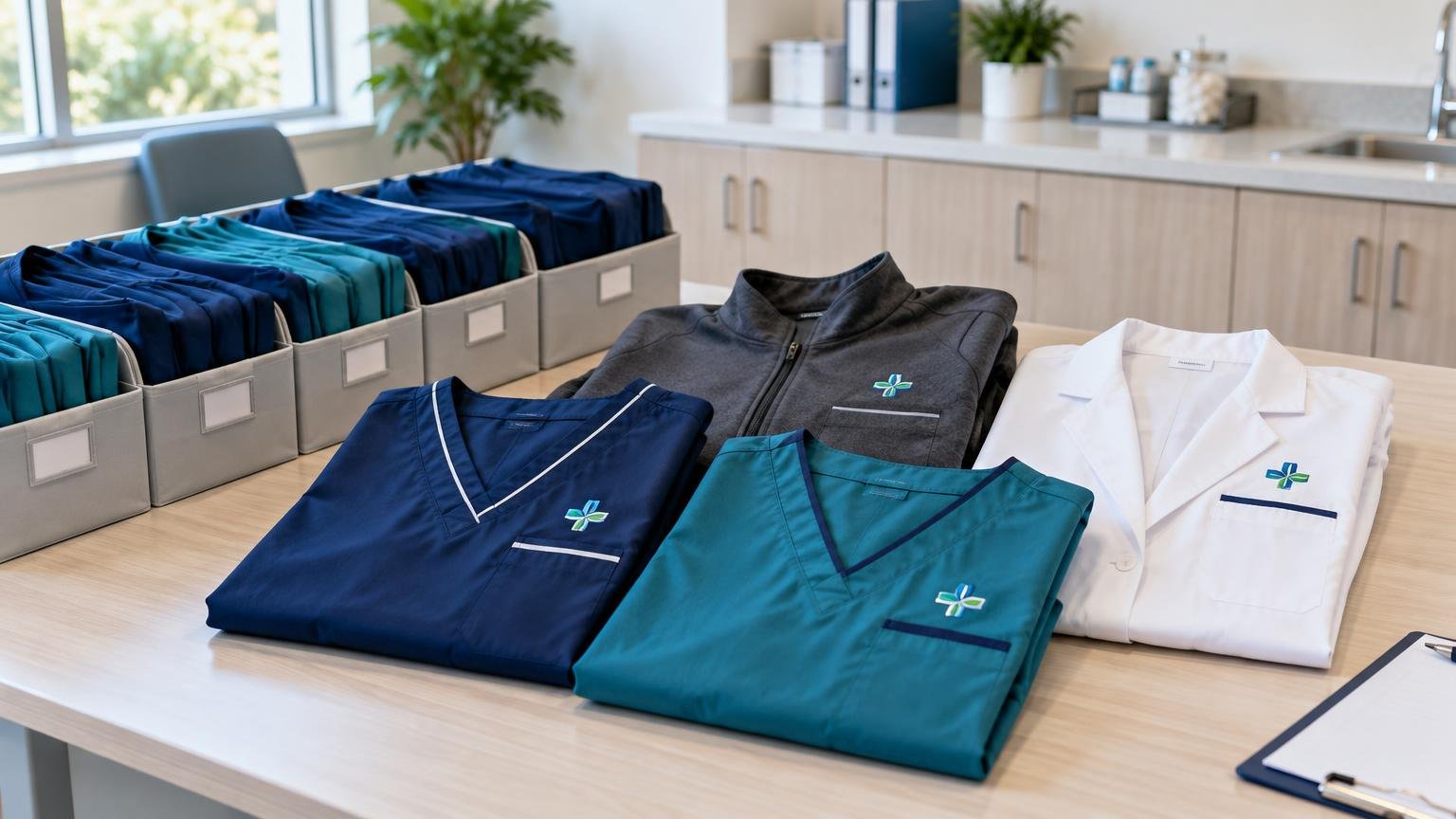
TLDR: A reliable healthcare staff apparel embroidery program starts with the job, not the logo. Define approved garments by role, decide how badges, colors, and embroidery will identify people, test decoration on each garment family, align the clothing with the real laundering process, and save a complete specification for reorders.
Treat healthcare staff apparel embroidery as an operating system rather than a one-time apparel purchase. The goal is a small, controlled menu that gives employees comfortable choices while preserving consistent colors, identification, branding, care instructions, and replacement ordering. Infection prevention, safety, HR, and department leaders should approve the standard before rollout because attire requirements differ among facilities and roles.
Start with the work environment and employee role
A single uniform rule rarely serves direct-care employees, laboratory teams, front-office staff, facilities personnel, and mobile workers equally well. Begin by documenting what each group does during a normal shift: how much they move, what they carry, where they work, what contamination or snag risks exist, and whether they move between indoor and outdoor environments.
Garment features should follow those requirements. An active role may benefit from stretch, side vents, reinforced seams, quick-drying fabric, secure pockets, or a badge loop. These are selection criteria rather than universal requirements. For example, one current scrub-top specification combines stretch fabric, moisture management, micro-ripstop construction, reinforced stitching, side vents, pockets, and a badge loop, illustrating the types of features buyers can compare rather than establishing one best garment for every facility.
| Role group | Useful garment questions | Likely program controls |
|---|---|---|
| Direct patient care | Does the garment allow reaching, bending, and long-shift movement? Are pockets appropriate for the role? | Approved scrub families, colors, fits, layers, and laundering instructions |
| Technical departments | Could loose features interfere with equipment or tasks? Are department-specific rules required? | Department approval, restricted layers, badge placement, and replacement process |
| Front office and administration | Is a scrub, polo, blouse, cardigan, or jacket appropriate for the setting? | Coordinated business-casual styles and consistent branding |
| Support and facilities | Does the work require greater abrasion resistance, visibility, or separate protective equipment? | Job-specific workwear reviewed by safety personnel |
| Mobile and community teams | Will employees move between buildings, vehicles, homes, and changing weather? | Approved outer layers, practical pockets, and clear organization identification |
Offer enough fit options to accommodate the workforce without turning the program into an unrestricted catalog. A practical menu might include two approved scrub fits, one warm-up jacket, and a limited number of nonclinical tops. Record the manufacturer, style code, color name, and size range for every choice. The same standardization principles used for role-based staff uniform programs also apply here, even though healthcare policies require their own review.
Build a clear identification hierarchy
An ID badge, garment color, facility logo, and embroidered role can work together, but they should not compete for attention. Establish which element carries each piece of information. The badge may remain the authoritative source for identity and access, while garment color indicates a department and embroidery provides organization branding or a short role label.
- Start with required identification, including the facility’s badge policy and any department rules.
- Decide whether garment color communicates a role, department, location, or nothing at all.
- Choose whether embroidery will show the organization logo, employee name, role, credentials, department, or a limited combination.
- Check readability at normal conversational distance and confirm that the result does not interfere with the badge.
- Document approved wording, abbreviations, capitalization, credential order, and privacy exceptions.
There is no universal healthcare color or embroidery code. Gundersen Health System’s published dress code, for example, describes local choices including role-specific colors and embroidery options such as a name with credentials and role, or a role alone. That demonstrates how detailed an organization-specific policy can be, not a standard other facilities must copy.
Keep embroidered text concise. A small logo plus several lines of names, credentials, departments, and slogans can become difficult to read and heavy on a lightweight scrub top. If the badge already displays a full name and credentials, embroidery may only need a logo or short role. Consult HR and privacy stakeholders before placing personal names on garments used in public-facing, behavioral-health, home-visit, or other sensitive settings.
Set healthcare apparel embroidery rules before ordering
The embroidery specification should be repeatable without relying on someone’s memory. Save the approved artwork version, digitized embroidery file, thread manufacturer and color references, finished dimensions, placement measurements, text rules, and a photograph or physical sample of the accepted result.
Do not force one embroidery size onto scrubs, polos, lab coats, fleeces, and jackets. Pocket position, plackets, panels, seams, stretch, and fabric weight change the usable decoration area. Build a controlled placement system for each garment family while keeping the logo’s visual proportions consistent. The same principle is useful when you need to match logos across different garment types.
- Avoid placing embroidery directly over bulky seams, zippers, pocket openings, or areas with frequent bending and friction.
- Check whether a chest logo will conflict with an ID badge, pen slot, stethoscope, radio, or pocket access.
- Use an approved text template for names, roles, credentials, and departments rather than typesetting each order from scratch.
- Request a physical sew-out on the intended garment or a materially comparable fabric before approving a large order.
- Approve each major garment family separately, especially when moving between lightweight stretch scrubs and heavier outerwear.
Stabilization matters because embroidery repeatedly drives thread through fabric. Madeira explains that cut-away backing supports fabric during and after embroidery, with selection affected by the fabric, design density, washing requirements, and wearer comfort. It also notes that backing used with industrial laundering or tunnel finishing must tolerate the relevant heat without distorting. A dense design that works on a structured jacket may need to be simplified, resized, or stabilized differently on a flexible scrub top.
Design for the real laundering model
Determine the care process before selecting garments and decoration. Ask whether employees wash ordinary uniforms at home, whether the facility launders them, or whether a contracted service handles the work. Record expected wash temperatures, drying methods, chemicals, pressing or tunnel-finishing processes, and how contaminated garments are collected.
CDC guidance says that when a healthcare facility requires uniforms, it should provide laundering provisions or cleaning guidance based on the tasks employees perform. Policies and applicable regulations govern the handling, transport, and laundering of soiled textiles. CDC guidance on laundry and bedding That makes care compatibility a purchasing requirement rather than an instruction to add after garments arrive.
Ordinary uniforms and protective clothing are not interchangeable. Under OSHA’s Bloodborne Pathogens Standard, employers are responsible for cleaning, laundering, repairing, replacing, or disposing of required personal protective equipment at no cost to employees. The standard distinguishes PPE from ordinary uniforms and work clothing not intended to protect against a hazard. OSHA’s Bloodborne Pathogens Standard CDC/NIOSH likewise provides standards and specifications for healthcare protective clothing selected for relevant exposure and barrier requirements.
Therefore, a logoed scrub top or fleece should not be treated as protective equipment merely because an employee wears it at work. Safety and infection-prevention leaders should determine when separate protective clothing is required, how it is selected, and who launders or disposes of it.
Standardize seasonal layers
Uncontrolled layers are a common source of visual inconsistency. Employees may otherwise introduce nearly matching fleeces, cardigans, hoodies, or jackets with different shades, logo positions, and care characteristics. Create an approved layer menu instead.
For every layer, specify the eligible roles, exact style and color, permitted work areas, closure type, sleeve requirements, decoration location, and laundering method. Consider whether the layer blocks a badge, drapes into a task area, traps too much heat, or lacks suitable pocket access. Mobile staff may need a separate outdoor option rather than wearing a bulky jacket through indoor clinical spaces.
Make reorders routine rather than custom projects
A reorder should reproduce an approved configuration, not reopen every design decision. Create a uniform-program record for each role and location, then control who can approve new styles or substitutions.
| Record | What to save |
|---|---|
| Garment identity | Manufacturer, style code, fit, exact color name, size range, and product revision if relevant |
| Decoration recipe | Artwork version, digitized file, thread references, dimensions, stitch or production notes, and placement measurements |
| Role rules | Eligible roles, required colors, allowed name or credential formats, and approved layers |
| Approval evidence | Dated sew-out approval, garment photographs, sample location, and approving stakeholders |
| Ordering controls | Authorized buyers, new-hire kit contents, replacement rules, order form, and shipping destinations |
| Substitution plan | Who approves replacements, which features and colors must match, and when a new sew-out is required |
Preserve the original style code even if employees order by a friendly name such as “women’s navy scrub top.” Color names are not reliable across manufacturers, and two garments described as navy may not match. If a style is discontinued, compare the replacement’s fabric, fit, color, pocket layout, care instructions, and decoration area. Then run a new fit review and sew-out rather than silently substituting it.
Plan replacement quantities around the laundering cycle and scheduling needs. Employees need enough approved garments to complete shifts while other pieces are being cleaned, but the appropriate number depends on shift patterns, laundry frequency, issued-versus-employee-owned policy, storage, and emergency replacement procedures.
Use a controlled rollout process
- Map roles, work environments, current dress rules, laundering routes, and protective-clothing requirements.
- Ask infection prevention, safety, HR, privacy, and department leaders to approve the proposed garment and identification rules.
- Obtain size samples across the approved fits and let a representative employee group check mobility, coverage, pocket access, and layering.
- Produce physical embroidery sew-outs on each major garment family and inspect appearance, comfort, placement, and badge interaction.
- Run a small pilot through normal work and the actual approved laundering process.
- Finalize the catalog, order form, artwork files, role eligibility, approval ownership, and substitution procedure.
- Schedule periodic reviews for garment discontinuations, workforce feedback, policy changes, and decoration consistency.
A pilot does not need to involve the entire organization. A representative group from the affected roles can reveal problems such as restricted reaching, inaccessible pockets, badge conflicts, uncomfortable backing, confusing role colors, or a layer that works indoors but not during mobile assignments.
Common questions about embroidered healthcare apparel
Should scrubs be embroidered, printed, or left undecorated?
Choose according to identification needs, fabric, artwork, laundering, comfort, quantity, and replacement workflow. Embroidery can provide a durable, professional mark, but a dense design may be unnecessarily heavy on a lightweight stretch garment. Some roles may only need an approved color and badge. Test the intended method on the actual garment family.
What information should be embroidered?
Use the shortest combination that adds information not already communicated clearly elsewhere. That may be a logo alone, a logo and role, or a name with approved credentials. Avoid turning the chest area into a duplicate of the employee’s badge. Establish one approved naming and credential format.
Can embroidered stretch scrubs remain comfortable?
They can, provided the design, stitch density, placement, backing, and garment are compatible. Comfort should be checked with a physical sew-out worn during realistic movement. Do not assume that settings developed for a firm polo or jacket will transfer directly to a lightweight stretch scrub.
Can employees launder embroidered uniforms at home?
That is a facility-policy decision based on the work performed and the classification of the garment. If home laundering is permitted for ordinary uniforms, provide clear care and transport instructions compatible with the garment and embroidery. Required PPE falls under different employer responsibilities and should follow the applicable safety program.
What happens when a garment is discontinued?
Do not allow an automatic substitution based only on a similar product photo or color name. Select a candidate using the saved requirements, review samples and sizing, compare the color under consistent lighting, and approve a new sew-out. Record the effective date so old and new versions can be managed during the transition.
Create the standard before placing the order
The most practical healthcare apparel program is usually a narrow, documented one: approved garments by role, a clear identification hierarchy, decoration specifications for each garment family, care rules aligned with actual laundering, controlled seasonal layers, and a complete reorder record. Start by mapping one department’s roles and laundry process. Approve its garments, fit samples, and sew-outs before expanding the system to the rest of the organization.
References
- Force Cross-Flex Men's V-Neck Scrub Top | Carhartt
- Employee Dress Code | Gundersen Health System
- Cut-away backings | Madeira
- G. Laundry and Bedding | Infection Control | CDC
- 1910.1030 – Bloodborne pathogens. | Occupational Safety and Health Administration
- Standards and Specifications | Healthcare Workers | CDC